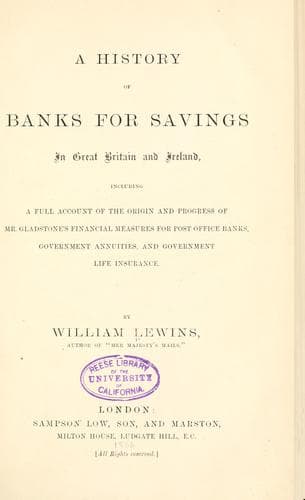
A History of Banks for Savings in Great Britain and IrelandLewins, William
History
A History of Banks for Savings in Great Britain and Ireland
Lewins, William
Postal savings banks -- Great Britain; Savings banks -- Great Britain
The Cuffe Street Savings Bank at Dublin was originally established in
1818 as the St. Peter's Parish Savings Bank. It was started by several
of the most influential gentlemen in Dublin, who formed themselves
into trustees and managers. The then Archbishop of Dublin, Archdeacon
Torrens, Judge Johnson, and Serjeant (afterwards Lord Chief Justice)
Lefroy being among the most prominent. On the strength of the
well-known character and wealth of the trustees, this bank from its
commencement did a very large business; so much so, that it was
calculated to have received in deposits in one year (1831, when the
bank was at its best,) no less than 100,000_l._ The bank began on an
unpretending scale enough, to judge by the appointment and pay of its
only salaried official.[62] This person was a Mr. Dunn, who combined
in 1818 the functions of sexton to the parish with which the bank was
immediately associated, with that of actuary of the bank, at a salary
of five pounds a-year. The rector of the parish was security for Dunn;
but all such considerations troubled the trustees but little. On the
strength of this person's religious character, for "he was a very
correct man,"[63] he soon became factotum. Almost from the first a boy
of the name of Ballance, whom Dunn had taken from a charity school,
was his book-keeper. This lad was also a kind of general servant of
Dunn's, living with him in his house, and soon became his perfect
tool. Without making him his confidant--for the actuary was too
cunning, as it seems, for that--he used him exactly as if he had been
one. For eight years Dunn managed solely the affairs of the bank,
giving the most perfect satisfaction to every one, depositors as well
as trustees. In 1826, however, a Mr. Lannigan, a barrister, comes
prominently upon the scene. This gentleman was a trustee, and seems to
have been dissatisfied with being one merely in name. Mr. Lannigan
began, therefore, a little "meddling," and from the way his
interference was received, this trustee, shrewder than the rest, began
to suspect something not quite right. He then looked narrowly into the
system of keeping accounts, and was not long in finding sufficient to
awaken the strongest suspicions of Dunn's malpractices. Dunn, however,
had not been asleep all this time. He not only with great ingenuity
kept his accounts as square as possible, but operated upon the
credulity of the other working trustees, and succeeded in getting a
party among the number to form a wall round him. On Mr. Lannigan
mentioning his suspicions to his brother trustees, Dunn's machinations
stood him in good stead: they would not hear anything to the prejudice
of this "very correct man." Mr. Lannigan repeated his attempts with
the same effect; was considered a suspicious and troublesome fellow,
and got no little abuse for his pains.[64] For five years it is said
this unseemly contest went on, and although this trustee succeeded so
Public-domain text, read in full here on John Shaqi.
Reviews
Reviews
No reviews yet
Be the first to share your thoughts on this work.
Elsewhere in the archive
Join the Discussion
Join the discussion
Sign in to leave a comment or review.
Sign InorCreate an account