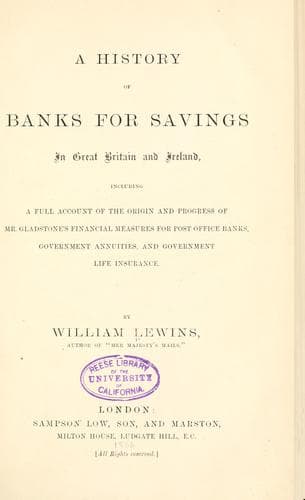
A History of Banks for Savings in Great Britain and IrelandLewins, William
History
A History of Banks for Savings in Great Britain and Ireland
Lewins, William
Postal savings banks -- Great Britain; Savings banks -- Great Britain
Mr. Pratt found out in making his awards that almost every legislative
enactment relating to Savings Banks had here been systematically
violated; that the bank itself had rules founded upon the Act, but
that they had all been evaded. Depositors had placed as much as
200_l._ in the bank in one year, and had received interest upon all
they had deposited; the same individuals were also found to have had
two different accounts in the bank. In all cases of this kind where a
deficiency existed Mr. Pratt ruled that the depositors could not
legally recover, but he recommended in his private capacity, that if
the bank were carried on, such sums might be paid out of the accruing
yearly profits. Mr. Pratt is said to have recommended in the same way
that the bank might go on under a fresh management, and seems to have
appointed another set of trustees for the purpose; at the same time
informing them that the National Debt Commissioners would _receive
without remark_ the yearly statements as usual, though those
statements must of necessity for some time to come exhibit an increase
of liabilities over assets. The bank was carried on, and against Mr.
Pratt's advice the whole of the claims were at once met, "with a
view," as the trustees said, "to induce a more perfect confidence." In
1845, the Government observing that year by year the bank was getting
into a worse financial position,[65] made an attempt to close it; but
on the case being submitted to the Attorney and Solicitor General,
they found they could not do so unless the Annual Returns were _not
sent_. The Returns, worthless as they were, had been regularly sent,
and thus the Executive was powerless. After another crisis at this
period, the bank finally went down in 1848, the liabilities amounting
to the sum of 56,000_l._ and about 90_l._ to meet it. The number of
depositors who had accounts with the bank at the time was 1,900,
nine-tenths of whom were poor people. In a debate which occurred in
the House of Commons immediately after this failure, Mr. Reynolds, the
member for Dublin, commented in strong terms on the conduct of the
National Debt Commissioners, who had known the state the bank was in
for fifteen years, and had never zealously interfered.[66] This member
also stated his intention to move for a Select Committee to
investigate the whole question. The Chancellor of the Exchequer said
he saw no objection to such a committee, and it was subsequently
appointed. The proceedings of that committee, and the assistance which
was given to the defrauded depositors after much debate, will be
referred to in their proper place in the next chapter.
Public-domain text, read in full here on John Shaqi.
Reviews
Reviews
No reviews yet
Be the first to share your thoughts on this work.
Elsewhere in the archive
Join the Discussion
Join the discussion
Sign in to leave a comment or review.
Sign InorCreate an account