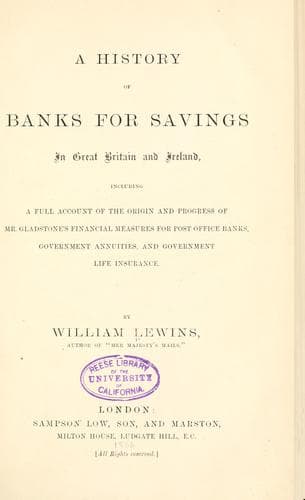
A History of Banks for Savings in Great Britain and IrelandLewins, William
History
A History of Banks for Savings in Great Britain and Ireland
Lewins, William
Postal savings banks -- Great Britain; Savings banks -- Great Britain
The fraud in connexion with the Hertford Savings Bank was one of the
earliest cases that occurred in England, the particulars of which have
been made known. This bank, as will be remembered, was one of the
first formed in this country. Like many more of the original banks,
this one was conducted on the principle of making it a Head office for
the surrounding district, with branch banks radiating from it as from
a centre. Clergymen, as has already been stated, almost exclusively
acted as the Agents for these branch banks. The Rev. Mr. Small, a
clergyman at St. Albans, acted in this capacity in that town, and in
the course of a connexion with this bank, extending over a period of
several years, contrived to embezzle the money entrusted to him to the
extent of 24,000_l._ This he did in two different ways. In the one
case, he received deposits and did not remit them; and in the other,
acting with due clerical discretion, he applied to the Head bank for
sums in the names of depositors for which he had not received their
warrants. The systematic frauds of this reverend gentleman were found
out when the St. Albans Bank was detached from the parent stock under
the erroneous impression that it was strong enough to commence
business on its own account. It appears that in this way the trustees
of the principal bank were only liable for half the amount of the
defalcations; but it ought to be placed on honourable record, that
eventually, through the liberality of the trustees, who, fortunately,
were principally rich noblemen, the poor depositors were reimbursed of
their losses in full. We have gathered the above facts from statements
made in the House of Lords in 1835, and as the question of the
liability of trustees and the security of deposits was then largely
introduced, it may be interesting to follow up the story with a few
remarks to which the case gave rise. The Marquis of Salisbury, one of
the trustees, asked the premier, Lord Melbourne, if the law, as it
then stood, could not be altered. The liability of trustees,
inculpating, as it might, innocent men, rendered many gentlemen most
anxious to withdraw their names from such offices. This was one horn
of the dilemma. The other was, how depositors could be made to feel
secure. "It was no trifling matter. When Savings Banks were first
formed, but few individuals could ever have expected that the sums
subscribed would amount to what they now were."[68] It was high time
that the security of these savings, and as to who was liable for them,
should be once for all distinctly settled. Lord Salisbury was sure no
one would like to remain a trustee without knowing the amount of his
liability. He then appealed to Viscount Melbourne--who with himself
was a trustee of the Hertfordshire Bank, and would have to pay a share
of the loss--whether he would not have a bill brought in to remedy the
grievance. Lord Melbourne thought it was not necessary. Much as he
Public-domain text, read in full here on John Shaqi.
Reviews
Reviews
No reviews yet
Be the first to share your thoughts on this work.
Elsewhere in the archive
Join the Discussion
Join the discussion
Sign in to leave a comment or review.
Sign InorCreate an account