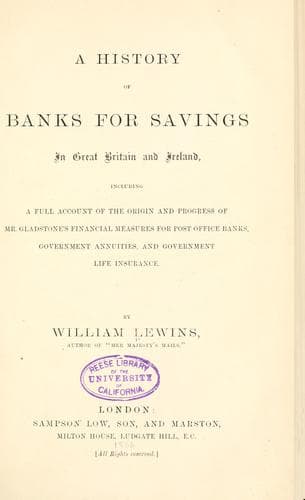
A History of Banks for Savings in Great Britain and IrelandLewins, William
History
A History of Banks for Savings in Great Britain and Ireland
Lewins, William
Postal savings banks -- Great Britain; Savings banks -- Great Britain
Mr. Goulburn spoke next on the question of liability of trustees.
Though the topic was engaging great attention out of doors, little was
said upon the point on this occasion: the section of the act thus
passed so quietly, was, however, pregnant with meaning, and, as it
turned out, pregnant with results. The clause provided that no trustee
or manager of any Savings Bank shall be liable to make good any
deficiency which may hereafter arise in the funds of any of these
institutions, unless these officers shall have respectively declared,
by writing under their hands, _that they are willing to be so
answerable_; and not only so, "but it shall be lawful for each of such
persons, or for such persons collectively, to limit his or their
responsibility to such sums as shall be specified in any such
instrument." This declaration was, of course, to be lodged with the
National Debt Commissioners. On a trustee or manager making it, he
became liable to make good every deficiency that might arise in the
bank with which he was connected, whether through his own
carelessness, or the cupidity of those under him; if a declaration of
this sort were not made, he was liable for nothing.[73]
The above were the three most important changes made in the law of
Savings Banks under Mr. Goulburn's Act, but there were several minor
clauses introduced into the bill which deserve mention, and which
were, there can be no doubt, equally with the more important sections,
the direct results of the systematic frauds already described. With
his eye direct on the Cuffe Street actuary, concerning whom the
Government knew more than was generally known in 1844, the Chancellor,
whilst studiously avoiding all mention of the Dublin case, spoke of
those who, ignorant of business, took their money to improper places,
and made deposits out of office hours. The fourth section of the Act
was, therefore, designed to meet such cases, by declaring any actuary
or cashier who should so take money out of course, and not account for
it at the very first meeting, to be guilty of a misdemeanour, and
liable to be punished for fraud. Section 5 required that deposit-books
should be produced at the bank at least once every year for purposes
of examination and check. Section 17 provided that bonds of sufficient
security shall be given by every officer of a Savings Bank trusted
with the receipt and custody of money, and that these bonds shall be
placed (not with the Clerk of the Peace as before this Act), but under
the charge of the National Debt Commissioners. The old arrangement
likewise for depositing the Rules of the bank with the Clerk of the
Peace was repealed by section 18, and in its place the next section
enacted, that when a new bank was proposed, two written or printed
copies of the Rules of such bank should be transmitted to the
Barrister for his certificate, who, on approval, was to send one copy
back to the Bank authorities, and the other forward to the National
Debt Office.
Public-domain text, read in full here on John Shaqi.
Reviews
Reviews
No reviews yet
Be the first to share your thoughts on this work.
Elsewhere in the archive
Join the Discussion
Join the discussion
Sign in to leave a comment or review.
Sign InorCreate an account