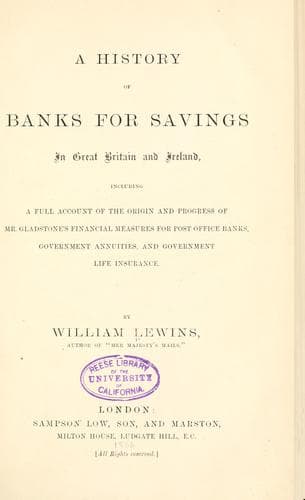
A History of Banks for Savings in Great Britain and IrelandLewins, William
History
A History of Banks for Savings in Great Britain and Ireland
Lewins, William
Postal savings banks -- Great Britain; Savings banks -- Great Britain
Early in 1848 a Committee of the House of Commons, consisting of the
Chancellor of the Exchequer, Mr. Goulburn, Mr. J. A. Smith, Sir J. Y.
Bullar, Mr. Shafto Adair, Mr. Bramston, Mr. Gibson Craig, Mr. Fagan,
Mr. H. Herbert, Mr. Herries, Mr. Hume, Mr. Reynolds, Mr. Poulett
Scrope, and Mr. Ker Seymour, was appointed to inquire into the state
of the Irish banks. As already related in the last chapter, the Cuffe
Street bank soon broke up after the trustees were enabled to take
refuge under the Act of 1844. Into this inquiry, which we have before
referred to, it is unnecessary to enter much further; it presents
little else than information relating to the flagrant breaches of
faith of officers to whom were entrusted the hard earnings of hundreds
of the poorest people living around them. The scope of the inquiry was
limited to Ireland. It seems to have been purposely intended that a
full investigation into the general Savings Bank question should not
now be made. The inquiry was not extended in any sense to the English
banks, though some of the most prominent English managers offered to
give evidence. Doubtless the Government feared that a full exposure of
the frauds in Savings Banks, an inquiry into several matters connected
with the disposal of Savings Bank money already beginning to be
mooted, might have the effect of shaking the confidence of the people.
People were openly saying that Government had not done its best to
make the Savings Bank a secure repository for the people; yet, rather
than raise this issue before a Committee of the House, it submitted to
have the investigation that _was_ made designated "a perfect
star-chamber business," and the members of Government themselves
subjected to great ridicule. The Committee sat only nine days, and
made a report to the House, which Lord George Bentinck characterized
as "the most extraordinary one that ever was presented to Parliament."
"It is as remarkable for its brevity as for its vacuity--as brief as
it is worthless." The report is certainly brief, and may here be given
without curtailment: "Your Committee," it commences, "has proceeded
with the inquiry entrusted to them by the House, but owing to the late
period of the session they have found themselves unable to bring it to
a satisfactory conclusion. They are of opinion that it is advisable
that a further inquiry should take place, either during the recess or
in the next session of Parliament, regulating the liability of
trustees, and providing for the appointment of _auditors_ to Savings
Banks."
Public-domain text, read in full here on John Shaqi.
Reviews
Reviews
No reviews yet
Be the first to share your thoughts on this work.
Elsewhere in the archive
Join the Discussion
Join the discussion
Sign in to leave a comment or review.
Sign InorCreate an account