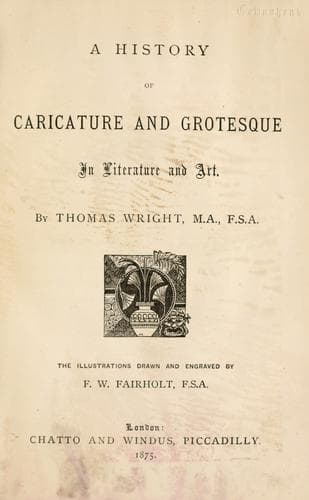
A History of Caricature and Grotesque in Literature and ArtWright, Thomas
History
A History of Caricature and Grotesque in Literature and Art
Wright, Thomas
Caricature -- History
is represented as a youth, arrived at years of maturity, who sorrows
over the spectacle of human vices and weaknesses, until he resolves to
go on a pilgrimage to Dame Nature, in order to expostulate with her
for having made him feeble to resist the temptations of the world,
and to entreat her assistance. On his way, he arrives successively at
the court of Venus and at the abode of Gluttony, which give him the
occasion to dwell at considerable length on the license and luxury
which prevailed among his contemporaries. He next reaches Paris, and
visits the famous mediæval university, and his satire on the manners of
the students and the fruitlessness of their studies, forms a remarkable
and interesting picture of the age. The pilgrim next arrives at the
Mount of Ambition, tempting by its beauty and by the stately palace
with which it was crowned, and here we are presented with a satire on
the manners and corruptions of the court. Near to this was the Hill of
Presumption, which was inhabited by ecclesiastics of all classes, great
scholastic doctors and professors, monks, and the like. It is a satire
on the manners of the clergy. As Architrenius turns from this painful
spectacle, he encounters a gigantic and hideous monster named Cupidity,
is led into a series of reflections upon the greediness and avarice
of the prelates, from which he is roused by the uproar caused by a
fierce combat between the prodigals and the misers. He is subsequently
carried to the island of far-distant Thule, which he finds to be the
resting-place of the philosophers of ancient Greece, and he listens
to their declamations against the vices of mankind. After this visit,
Architrenius reaches the end of his pilgrimage. He finds Nature in the
form of a beautiful woman, dwelling with a host of attendants in the
midst of a flowery plain, and meats with a courteous reception, but she
begins by giving him a long lecture on natural philosophy. After this
is concluded, Dame Nature listens to his complaints, and, to console
him, gives him a handsome woman, named Moderation, for a wife, and
dismisses him with a chapter of good counsels on the duties of married
life. The general moral intended to be inculcated appears to be that
the retirement of domestic happiness is to be preferred to the vain and
heartless turmoils of active life in all its phases. It will be seen
that the kind of allegory which subsequently produced the "Pilgrim's
Progress," had already made its appearance in mediæval literature.
Public-domain text, read in full here on John Shaqi.
Reviews
Reviews
No reviews yet
Be the first to share your thoughts on this work.
Elsewhere in the archive
Join the Discussion
Join the discussion
Sign in to leave a comment or review.
Sign InorCreate an account