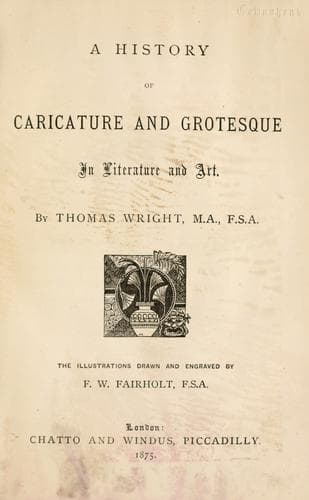
A History of Caricature and Grotesque in Literature and ArtWright, Thomas
History
A History of Caricature and Grotesque in Literature and Art
Wright, Thomas
Caricature -- History
While, after the fifteenth century the profession of the minstrel
became entirely degraded, and he was looked upon more than ever as a
rogue and vagabond, the fiddle accompanied him, and it long remained,
as it still remains in Ireland, the favourite instrument of the
peasantry. The blind fiddler, even at the present day, is not unknown
in our rural districts. It has always been in England the favourite
instrument of minstrelsy.
CHAPTER XII.
THE COURT FOOL.--THE NORMANS AND THEIR GABS.--EARLY HISTORY OF COURT
FOOLS.--THEIR COSTUME.--CARVINGS IN THE CORNISH CHURCHES.--THE
BURLESQUE SOCIETIES OF THE MIDDLE AGES.--THE FEASTS OF ASSES, AND
OF FOOLS.--THEIR LICENCE.--THE LEADEN MONEY OF THE FOOLS.--THE
BISHOP'S BLESSING.
From the employment of minstrels attached to the family, probably arose
another and well-known character of later times, the court fool, who
took the place of satirist in the great households. I do not consider
what we understand by the court fool to be a character of any great
antiquity.
It is somewhat doubtful whether what we call a jest, was really
appreciated in the middle ages. Puns seem to have been considered
as elegant figures of speech in literary composition, and we rarely
meet with anything like a quick and clever repartee. In the earlier
ages, when a party of warriors would be merry, their mirth appears
to have consisted usually in ridiculous boasts, or in rude remarks,
or in sneers at enemies or opponents. These jests were termed by the
French and Normans _gabs_ (_gabæ_, in mediæval Latin), a word supposed
to have been derived from the classical Latin word _cavilla_, a mock
or taunt; and a short poem in Anglo-Norman has been preserved which
furnishes a curious illustration of the meaning attached to it in the
twelfth century. This poem relates how Charlemagne, piqued by the
taunts of his empress on the superiority of Hugh the Great, emperor
of Constantinople, went to Constantinople, accompanied by his _douze
pairs_ and a thousand knights, to verify the truth of his wife's story.
They proceeded first to Jerusalem, where, when Charlemagne and his
twelve peers entered the Church of the Holy Sepulchre, they looked so
handsome and majestic, that they were taken at first for Christ and
his twelve apostles, but the mystery was soon cleared up, and they were
treated by the patriarch with great hospitality during four months.
They then continued their progress till they reached Constantinople,
where they were equally well received by the emperor Hugo. At night
the emperor placed his guests in a chamber furnished with thirteen
splendid beds, one in the middle of the room, and the other twelve
distributed around it, and illuminated by a large carbuncle, which gave
a light as bright as that of day. When Hugh left them in their quarters
for the night, he lent them wine and whatever was necessary to make
them comfortable; and, when alone, they proceeded to amuse themselves
Public-domain text, read in full here on John Shaqi.
Reviews
Reviews
No reviews yet
Be the first to share your thoughts on this work.
Elsewhere in the archive
Join the Discussion
Join the discussion
Sign in to leave a comment or review.
Sign InorCreate an account