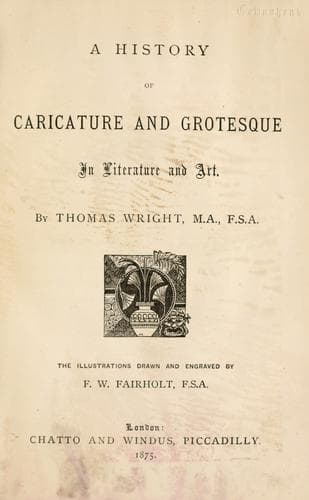
A History of Caricature and Grotesque in Literature and ArtWright, Thomas
History
A History of Caricature and Grotesque in Literature and Art
Wright, Thomas
Caricature -- History
In such trials of skill as this, an individual must continually have
arisen who excelled in some at least of the qualities needful for
raising mirth and making him a good companion, by showing himself more
brilliant in wit, or more biting in sarcasms, or more impudent in his
jokes, and he would thus become the favourite mirth-maker of the court,
the boon companion of the chieftain and his followers in their hours of
relaxation. We find such an individual not unusually introduced in the
early romances and in the mythology of nations, and he sometimes unites
the character of court orator with the other. Such a personage was the
Sir Kay of the cycle of the romances of king Arthur. I have remarked
in a former chapter that Hunferth, in the Anglo-Saxon poem of Beowulf,
is described as holding a somewhat similar position at the court of
king Hrothgar. To go farther back in the mythology of our forefathers,
the Loki of Scandinavian fable appears sometimes to have performed a
similar character in the assembly of his fellow deities; and we know
that, among the Greeks, Homer on one occasion introduces Vulcan acting
the part of joker (γελωτοποιὸς) to the gods of Olympus. But all these
have no relationship whatever to the court-fool of modern times.
The German writer Flögel, in his "History of Court Fools,"[67] has
thrown this subject into much confusion by introducing a great mass
of irrelevant matter; and those who have since compiled from Flögel,
have made the confusion still greater. Much of this confusion has
arisen from the misunderstanding and confounding of names and terms.
The mimus, the joculator, the ministrel, or whatever name this class
of society went by, was not in any respects identical with what we
understand by a court fool, nor does any such character as the latter
appear in the feudal household before the fourteenth century, as
far as we are acquainted with the social manners and customs of the
olden time. The vast extent of the early French _romans de geste_, or
Carlovingian romances, which are filled with pictures of courts both of
princes and barons, in which the court fool must have been introduced
had he been known at the time they were composed, that is, in the
twelfth and thirteenth centuries, contains, I believe, no trace of such
personage; and the same may be said of the numerous other romances,
fabliaux, and in fact all the literature of that period, one so rich in
works illustrative of contemporary manners in their most minute detail.
From these facts I conclude that the single brief charter published
by M. Rigollot from a manuscript in the Imperial Library in Paris,
is either misunderstood or it presents a very exceptional case. By
this charter, John, king of England, grants to his _follus_, William
Picol, or Piculph (as he is called at the close of the document), an
estate in Normandy named in the document Fons Ossanæ (Menil-Ozenne in
Mortain), with all its appurtenances, "to have and to hold, to him and
Public-domain text, read in full here on John Shaqi.
Reviews
Reviews
No reviews yet
Be the first to share your thoughts on this work.
Elsewhere in the archive
Join the Discussion
Join the discussion
Sign in to leave a comment or review.
Sign InorCreate an account