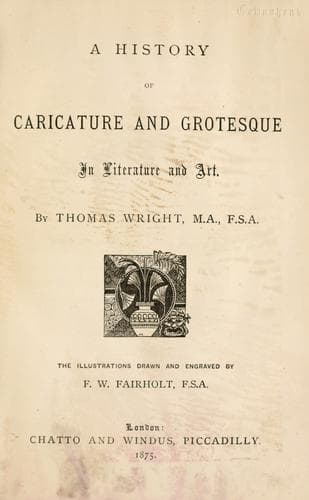
A History of Caricature and Grotesque in Literature and ArtWright, Thomas
History
A History of Caricature and Grotesque in Literature and Art
Wright, Thomas
Caricature -- History
The people in the middle ages, as well as its superiors, had its
comic literature and legend. Legend was the literature especially of
the peasant, and in it the spirit of burlesque and satire manifested
itself in many ways. Simplicity, combined with vulgar cunning, and the
circumstances arising out of the exercise of these qualities, presented
the greatest stimulants to popular mirth. They produced their popular
heroes, who, at first, were much more than half legendary, such as
the familiar spirit, Robin Goodfellow, whose pranks were a source of
continual amusement rather than of terror to the simple minds which
listened to those who told them. These stories excited with still
greater interest as their spiritual heroes became incarnate, and the
auditors were persuaded that the perpetrators of so many artful acts of
cunning and of so many mischievous practical jokes, were but ordinary
men like themselves. It was but a sign or symbol of the change from
the mythic age to that of practical life. One of the earliest of these
stories of mythic comedy transformed into, or at least presented under
the guise of, humanity, is that of Brother Ruth. Although the earliest
version of this story with which we are acquainted dates only from the
beginning of the sixteenth century,[73] there is no reason for doubt
that the story itself was in existence at a much more remote period.
[73] This earliest known version is in German verse, and was printed
in 1515. An English version, in prose, was printed in 1620, and
is reprinted in Thoms's "Collection of Early Prose Romances."
Public-domain text, read in full here on John Shaqi.
Reviews
Reviews
No reviews yet
Be the first to share your thoughts on this work.
Elsewhere in the archive
Join the Discussion
Join the discussion
Sign in to leave a comment or review.
Sign InorCreate an account