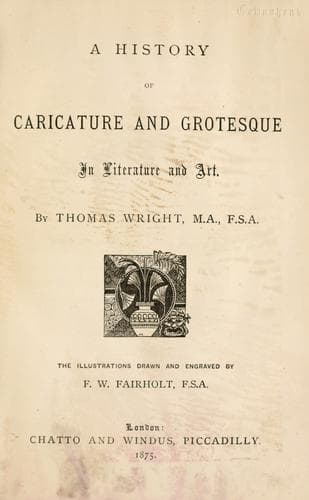
A History of Caricature and Grotesque in Literature and ArtWright, Thomas
History
A History of Caricature and Grotesque in Literature and Art
Wright, Thomas
Caricature -- History
These two tales are rather favourable specimens of the collection
published under the name of Skelton, which, as far as we know, was
first printed about the middle of the sixteenth century. The collection
of the jests of Scogan, or, as he was popularly called, Scogin, which
is said to have been compiled by Andrew Borde, was probably given to
the world a few years before, but no copies of the earlier editions are
now known to exist. Scogan, the hero of these jests, is described as
occupying at the court of Henry VII. a position not much different from
that of an ordinary court-fool. Good old Holinshed the chronicler says
of him, perhaps a little too gently, that he was "a learned gentleman
and student for a time in Oxford, of a pleasant wit, and bent to merrie
devices, in respect whereof he was called into the court, where, giving
himselfe to his naturall inclination of mirth and pleasant pastime,
he plaied manie sporting parts, although not in such uncivil manner
as hath beene of him reported." This allusion refers most probably to
the jests, which represent him as leading a life of low and coarse
buffoonery, in the course of which he displayed a considerable
share of the dishonest and mischievous qualities of the less real
Eulenspiegel. He is even represented as personally insulting the king
and queen, and as being consequently banished over the Channel, to
show no more respect to the majesty of the king of France. Scogin's
jests, like Skelton's, consist in a great measure of those practical
jokes which appear in all former ages to have been the delight of the
Teutonic race. Many of them are directed against the ignorance and
worldliness of the clergy. Scogin is described as being at one time
himself a teacher in the university, and on one occasion, we are told,
a husbandman sent his son to school to him that he might be made a
priest. The whole story, which runs through several chapters, is an
excellent caricature on the way in which men vulgarly ignorant were
intruded into the priesthood before the Reformation. At length, after
much blundering, the scholar came to be ordained, and his examination
is reported as follows:--
"_How the scholler said Tom Miller of Oseney was Jacob's father._
Public-domain text, read in full here on John Shaqi.
Reviews
Reviews
No reviews yet
Be the first to share your thoughts on this work.
Elsewhere in the archive
Join the Discussion
Join the discussion
Sign in to leave a comment or review.
Sign InorCreate an account