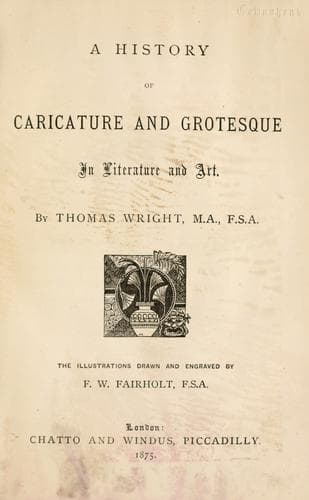
A History of Caricature and Grotesque in Literature and ArtWright, Thomas
History
A History of Caricature and Grotesque in Literature and Art
Wright, Thomas
Caricature -- History
The reign of Folly did not pass away with the fifteenth century--on the
whole the sixteenth century can hardly be said to have been more sane
than its predecessor, but it was agitated by a long and fierce struggle
to disengage European society from the trammels of the middle ages. We
have entered upon what is technically termed the _renaissance_, and
are approaching the great religious reformation. The period during
which the art of printing began first to spread generally over Western
Europe, was peculiarly favourable to the production of satirical
books and pamphlets, and a considerable number of clever and spirited
satirists and comic writers appeared towards the end of the fifteenth
century, especially in Germany, where circumstances of a political
character had at an early period given to the intellectual agitation
a more permanent strength than it could easily or quickly gain in the
great monarchies. Among the more remarkable of these satirists was
Thomas Murner, who was born at Strasburg, in 1475. The circumstances
even of his childhood are singular, for he was born a cripple, or
became one in his earliest infancy, though he was subsequently healed,
and it was so universally believed that this malady was the effect
of witchcraft, that he himself wrote afterwards a treatise upon this
subject under the title of "De Phitonico Contractu." The school in
which he was taught may at least have encouraged his satirical spirit,
for his master was Jacob Locher, the same who translated into Latin
verse the "Ship of Fools" of Sebastian Brandt. At the end of the
century Murner had become a master of arts in the University of Paris,
and had entered the Franciscan order. His reputation as a German
popular poet was so great, that the emperor Maximilian[ ]I., who
died in 1519, conferred upon him the crown of poetry, or, in other
words, made him poet-laureat. He took the degree of doctor in theology
in 1509. Still Murner was known best as the popular writer, and he
published several satirical poems, which were remarkable for the bold
woodcuts that illustrated them, for engraving on wood flourished at
this period. He exposed the corruptions of all classes of society,
and, before the Reformation broke out, he did not even spare the
corruptions of the ecclesiastical state, but soon declared himself a
fierce opponent of the Reformers. When the Lutheran revolt against the
Papacy became strong, our king, Henry VIII., who took a decided part
against Luther, invited Murner to England, and on his return to his
own country, the satiric Franciscan became more bitter against the
Reformation than ever. He advocated the cause of the English monarch in
a pamphlet, now very rare, in which he discussed the question whether
Henry VIII. or Luther was the liar--"Antwort dem Murner uff seine
frag, ob der künig von Engllant ein Lügner sey oder Martinus Luther."
Murner appears to have divided the people of his age into rogues and
Public-domain text, read in full here on John Shaqi.
Reviews
Reviews
No reviews yet
Be the first to share your thoughts on this work.
Elsewhere in the archive
Join the Discussion
Join the discussion
Sign in to leave a comment or review.
Sign InorCreate an account