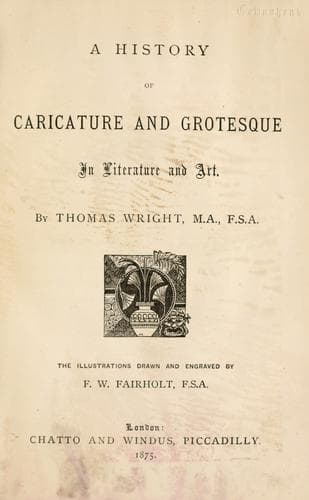
A History of Caricature and Grotesque in Literature and ArtWright, Thomas
History
A History of Caricature and Grotesque in Literature and Art
Wright, Thomas
Caricature -- History
and described the effects of his song over all the other animals; and
he published, also in verse, what he called a Monument, or Lament, on
his death ("Ein Denkmal oder Klagred' ob der Leiche Doktors Martin
Luther"). Among the numerous broadsides published by Hans Sachs, one
contains the very clever caricature of which we give a copy in our cut
No. 152. It is entitled "Der gut Hirt und böss Hirt," the good shepherd
and bad shepherd, and has for its text the opening verses of the tenth
chapter of the gospel of St. John. The good and bad shepherds are,
as may be supposed, Christ and the pope. The church is here pictured
as a not very stately building; the entrance, especially, is a plain
structure of timber. Jesus said to the Pharisees, "He that entereth not
by the door into the sheepfold, but climbeth up some other way, the
same is a thief and a robber. But he that entereth in by the door is
the shepherd of the flock." In the engraving, the pope, as the hireling
shepherd, sits on the roof of the stateliest part of the building,
pointing out to the Christian flock the wrong way, and blessing the
climbers. Under him two men of worldly distinction are making their
way into the church through a window; and on a roof below a friar is
pointing to the people the way up. At another window a monk holds
out his arms to invite people up; and one in spectacles, no doubt
emblematical of the doctors of the church, is looking out from an
opening over the entrance door to watch the proceedings of the Good
Shepherd. To the right, on the papal side of the church, the lords
and great men are bringing the people under their influence, till
they are stopped by the cardinals and bishops, who prevent them from
going forward to the door and point out very energetically the way
up the roof. At the door stands, the Saviour, as the good shepherd,
who has knocked, and the porter has opened it with his key. Christ's
true teachers, the evangelists, show the way to the solitary man of
worth who comes by this road, and who listens with calm attention to
the gospel teachers, while he opens his purse to bestow his charity
on the poor man by the road side. In the original engraving, in the
distance on the left, the Good Shepherd is seen followed by his flock,
who are obedient to his voice; on the right, the bad shepherd, who has
ostentatiously drawn up his sheep round the image of the cross, is
abandoning them, and taking to flight on the approach of the wolf. "He
that entereth in by the door is the shepherd of the sheep. To him the
porter openeth; and the sheep hear his voice, and he calleth his own
sheep by name, and leadeth them out. And when he putteth forth his own
sheep he goeth before them, and the sheep follow him, for they know his
voice.... But he that is an hireling, and not the shepherd, whose own
the sheep are not, seeth the wolf coming, and leaveth the sheep, and
fleeth; and the wolf catcheth them, and scattereth the sheep." (John x.
2-4, 12.)
Public-domain text, read in full here on John Shaqi.
Reviews
Reviews
No reviews yet
Be the first to share your thoughts on this work.
Elsewhere in the archive
Join the Discussion
Join the discussion
Sign in to leave a comment or review.
Sign InorCreate an account