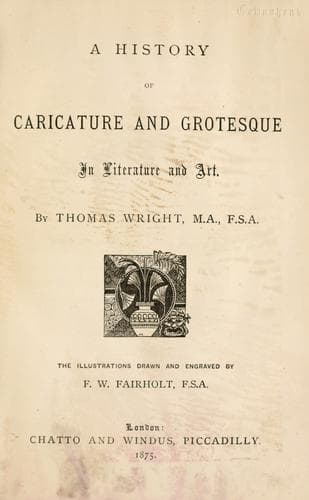
A History of Caricature and Grotesque in Literature and ArtWright, Thomas
History
A History of Caricature and Grotesque in Literature and Art
Wright, Thomas
Caricature -- History
While Luther was heroically fighting the great fight of reform in
Germany, the foundation of religious reform was laid in France by
John Calvin, a man equally sincere and zealous in the cause, but of
a totally different temper, and he espoused doctrines and forms of
church government which a Lutheran would not admit. Literary satire
was used with great effect by the French Calvinists against their
popish opponents, but they have left us few caricatures or burlesque
engravings of any kind; at least, very few belonging to the earlier
period of their history. Jaime, in his "Musée de Caricature," has given
a copy of a very rare plate, representing the pope struggling with
Luther and Calvin, as his two assailants. Both are tearing the pope's
hair, but it is Calvin who is here armed with the Bible, with which
he is striking at Luther, who is pulling him by the beard. The pope
has his hands upon their heads. This scene takes place in the choir of
a church, but I give here (cut No. 154) only the group of the three
combatants, intended to represent how the two great opponents to papal
corruptions were hostile at the same time to each other.
[Illustration: _No. 154. Luther and Calvin._]
CHAPTER XVI.
ORIGIN OF MEDIÆVAL FARCE AND MODERN COMEDY.--HROTSVITHA.--MEDIÆVAL
NOTIONS OF TERENCE.--THE EARLY RELIGIOUS PLAYS.--MYSTERIES AND
MIRACLE PLAYS.--THE FARCES.--THE DRAMA IN THE SIXTEENTH CENTURY.
There is still another branch of literature which, however it may have
been modified, has descended to us from the middle ages. It has been
remarked more than once in the course of this book, that the theatre
of the Romans perished in the transition from the empire to the middle
ages; but something in the shape of theatrical performances appears
to be inseparable from society even in its most barbarous state, and
we soon trace among the peoples who had settled upon the ruins of the
empire of Rome an approach towards a drama. It is worthy of remark,
too, that the mediæval drama originated exactly in the same way as that
of ancient Greece, that is, from religious ceremonies.
Public-domain text, read in full here on John Shaqi.
Reviews
Reviews
No reviews yet
Be the first to share your thoughts on this work.
Elsewhere in the archive
Join the Discussion
Join the discussion
Sign in to leave a comment or review.
Sign InorCreate an account