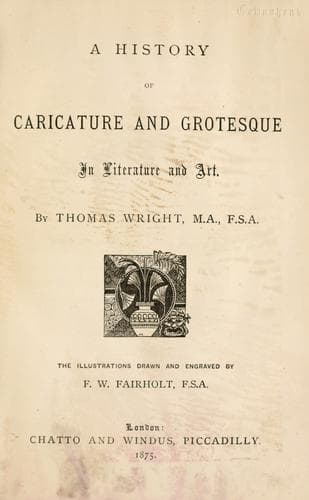
A History of Caricature and Grotesque in Literature and ArtWright, Thomas
History
A History of Caricature and Grotesque in Literature and Art
Wright, Thomas
Caricature -- History
The art of engraving on copper, although it had made rapid advances
during the sixteenth century, was still very far from perfection; but
the close of that century witnessed the birth of a man who was destined
not only to give a new character to this art, but also to bring in a
new style of caricature and burlesque. This was the celebrated Jacques
Callot, a native of Lorraine, and descended from a noble Burgundian
family. His father, Jean Callot, held the office of herald of Lorraine.
Jacques was born in the year 1592,[91] at Nancy, and appears to have
been destined for the church, with a view to which his early education
was regulated. But the early life of Jacques Callot presents a
romantic episode in the history of art aspirations. While yet hardly
more than an infant, he seized every opportunity of neglecting more
serious studies to practise drawing, and he displayed especially a
very precocious taste for satire, for his artistic talent was shown
principally in caricaturing all the people he knew. His father, and
apparently all his relatives, disapproved of his love for drawing, and
did what they could to discourage it; but in vain, for he still found
means of indulging it. Claude Henriet, the painter to the court of
Lorraine, gave him lessons, and his son, Israel Henriet, formed for
him a boy's friendship. He also learnt the elements of the art of
engraving of Demange Crocq, the engraver to the duke of Lorraine.
[91] This is the date fixed by Meaume, in his excellent work on
Callot, entitled "Recherches sur la Vie et les Ouvrages de
Jacques Callot," 2 tom. 8vo., 1860.
Public-domain text, read in full here on John Shaqi.
Reviews
Reviews
No reviews yet
Be the first to share your thoughts on this work.
Elsewhere in the archive
Join the Discussion
Join the discussion
Sign in to leave a comment or review.
Sign InorCreate an account