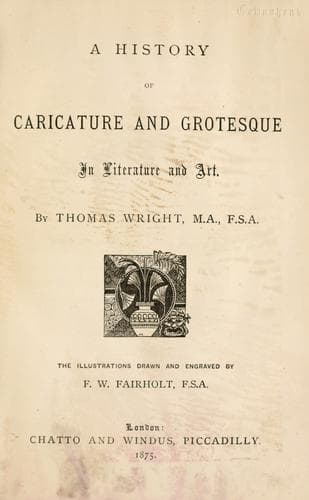
A History of Caricature and Grotesque in Literature and ArtWright, Thomas
History
A History of Caricature and Grotesque in Literature and Art
Wright, Thomas
Caricature -- History
The taste for macaronics passed rather early, like all other fashions
in that age, from Italy into France, where it first brought into
literary reputation a man who, if he had not the great talent of
Folengo, possessed a very considerable amount of wit and gaiety.
Antoine de la Sable, who Latinised his name into Antonius de Arena,
was born of a highly respectable family at Soliers, in the diocese
of Toulon, about the year 1500, and, being destined from his youth
to follow the profession of the law, studied under the celebrated
jurisconsult Alciatus. He had only arrived at the simple dignity of
_juge_, at St. Remy, in the diocese of Arles, when he died in the year
1544. In fact, he appears to have been no very diligent student, and we
gather from his own confessions that his youth had been rather wild.
The volume containing his macaronics, the second edition of which (as
far as the editions are known) was printed in 1529, bears a title which
will give some notion of the character of its contents,--"_Provencalis
de bragardissima villa de Soleriis, ad suos compagnones qui sunt de
persona friantes, bassas dansas et branlas practicantes novellas, de
guerra Romana, Neapolitana, et Genuensi mandat; una cum epistola ad
falotissimam suam garsam, Janam Rosæam, pro passando tempora_"--(_i.e._
a Provençal of the most swaggering town of Soliers, sends this to his
companions, who are dainty of their persons, practising basse dances
and new brawls, concerning the war of Rome, Naples, and Genoa; with an
epistle to his most merry wench, Jeanne Rosée, for pastime). In the
first of these poems Arena traces in his burlesque verse, which is an
imitation of Folengo, his own adventures and sufferings in the war in
Italy which led to the sack of Rome, in 1527, and in the subsequent
expeditions to Naples and Genoa. From the picture of the horrors of
war, he passes very willingly to describe the joyous manners of the
students in Provençal universities, of whom he tells us, that they are
all fine gallants, and always in love with the pretty girls.
_Gentigalantes sunt omnes instudiantes,
Et bellas garsas semper amare solent._
Public-domain text, read in full here on John Shaqi.
Reviews
Reviews
No reviews yet
Be the first to share your thoughts on this work.
Elsewhere in the archive
Join the Discussion
Join the discussion
Sign in to leave a comment or review.
Sign InorCreate an account