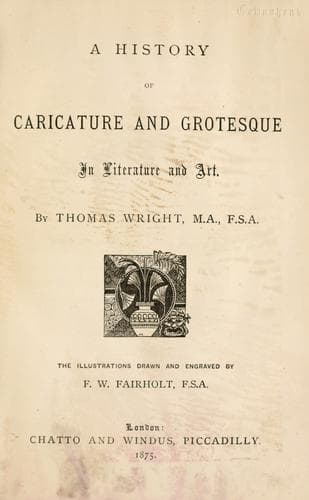
A History of Caricature and Grotesque in Literature and ArtWright, Thomas
History
A History of Caricature and Grotesque in Literature and Art
Wright, Thomas
Caricature -- History
and others, and I will boast that you are my friend, and you are a
much better poet than he."
The war against the secular poets, or advocates of the new learning,
is kept up with spirit through this ludicrous correspondence. One
correspondent presses Ortuinus Gratius to "write to me whether it be
necessary for eternal salvation that scholars learn grammar from the
secular poets, such as Virgil, Tullius, Pliny, and others; for," he
adds, "it seems to me that this is not a good method of studying." "As
I have often written to you," says another, "I am grieved that this
ribaldry (_ista ribaldria_), namely, the faculty of poetry, becomes
common, and is spread through all provinces and regions. In my time
there was only one poet, who was called Samuel; and now, in this city
alone, there are at least twenty, and they vex us all who hold with the
ancients. Lately I thoroughly defeated one, who said that _scholaris_
does not signify a person who goes to the school for the purpose of
learning; and I said, 'Ass! will you correct the holy doctor who
expounded this word?'" The new learning was, of course, identified
with the supporters of Reuchlin. "It is said here," continues the same
correspondent, "that all the poets will side with doctor Reuchlin
against the theologians. I wish all the poets were in the place where
pepper grows, that they might let us go in peace!"
Master William Lamp, "master of arts," sends to Master Ortuinus
Gratius, a narrative of his adventures in a journey from Cologne to
Rome. First he went to Mayence, where his indignation was moved by the
open manner in which people spoke in favour of Reuchlin, and when he
hazarded a contrary opinion, he was only laughed at, but he held his
tongue, because his opponents all carried arms and looked fierce. "One
of them is a count, and is a long man, and has white hair; and they
say that he takes a man in armour in his hand, and throws him to the
ground, and he has a sword as long as a giant; when I saw him, then I
held my tongue." At Worms, he found things no better, for the "doctors"
spoke bitterly against the theologians, and when he attempted to
expostulate, he got foul words as well as threats, a learned doctor in
medicine affirming "_quod merdaret super nos omnes_." On leaving Worms,
Lamp and his companion, another theologist, fell in with plunderers who
made them pay two florins to drink, "and I said _occulte_, Drink what
may the devil bless to you!" Subsequently they fell into low amours
at country inns, which are described coarsely, and then they reached
Insprucken, where they found the emperor, and his court and army, with
whole manners and proceedings Magister Lamp became sorely disgusted.
I pass over other adventures till they reach Mantua, the birthplace
of Virgil, and of a late mediæval Latin poet, named from it Baptista
Mantuanus. Lamp, in his hostile spirit towards the "secular poets,"
proceeds,--"And my companion said, 'Here Virgil was born.' I replied,
Public-domain text, read in full here on John Shaqi.
Reviews
Reviews
No reviews yet
Be the first to share your thoughts on this work.
Elsewhere in the archive
Join the Discussion
Join the discussion
Sign in to leave a comment or review.
Sign InorCreate an account