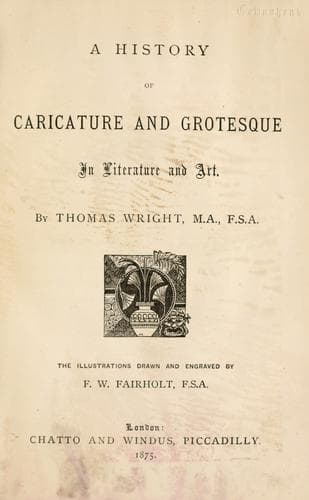
A History of Caricature and Grotesque in Literature and ArtWright, Thomas
History
A History of Caricature and Grotesque in Literature and Art
Wright, Thomas
Caricature -- History
obscene ribaldry, than can be found in the macaronics of Folengo,
in the "Epistolæ Obscurorum Virorum," or in the works of any of the
other satirists who had preceded him, or were his contemporaries. It
is a broad caricature, poor enough in its story, but enriched with
details, which are brilliant with imagery, though generally coarse,
and which are made the occasions for turning to ridicule everything
that existed. The five books of this romance were published separately
and at different periods, apparently without any fixed intention of
continuing them. The earlier editions of the first part were published
without date, but the earliest editions with dates belong to the year
1535, when it was several times reprinted. It appeared as the life of
Gargantua. This hero is supposed to have flourished in the first half
of the fifteenth century, and to have been the son of Grandgousier,
king of Utopia, a country which lay somewhere in the direction of
Chinon, a prince of an ancient dynasty, but a jovial fellow, who loved
good eating and drinking better than anything else. Grandgousier
married Gargamelle, daughter of the king of the Parpaillos, who became
the mother of Gargantua. The first chapters relate rather minutely
how the child was born, and came out at its mother's ear, why it was
called Gargantua, how it was dressed and treated in infancy, what were
its amusements and disposition, and how Gargantua was put to learning
under the sophists, and made no progress. Thereupon Grandgousier sent
his son to Paris, to seek instruction there, and he proceeds thither
mounted on an immense mare, which had been sent as a present by the
king of Numidia--it must be borne in mind that the royal race of Utopia
were all giants. At Paris the populace assembled tumultuously to
gratify their curiosity in looking at this new scholar; but Gargantua,
besides treating them in a very contemptuous manner, carried off the
great bells of Notre Dame to suspend at the neck of his mare. Great
was the indignation caused by this theft. "All the city was risen up
in sedition, they being, as you know, upon any slight occasions, so
ready to uproars and insurrections, that foreign nations wonder at the
patience of the kings of France, who do not by good justice restrain
them from such tumultuous courses." The citizens take counsel, and
resolve on sending one of the great orators of the university, Master
Janotus de Bragmardo, to expostulate with Gargantua, and obtain the
restoration of the bells. The speech which this worthy addresses to
Gargantua, in fulfilment of his mission, is an amusing parody on the
pedantic style of Parisian oratory. The bells, however, are recovered,
and Gargantua, under skilful instructors, pursues his studies with
credit, until he is suddenly called home by a letter from his father.
In fact, Grandgousier was suddenly involved in a war with his neighbour
Picrocole, king of Lerné, caused by a quarrel about cakes between some
Public-domain text, read in full here on John Shaqi.
Reviews
Reviews
No reviews yet
Be the first to share your thoughts on this work.
Elsewhere in the archive
Join the Discussion
Join the discussion
Sign in to leave a comment or review.
Sign InorCreate an account