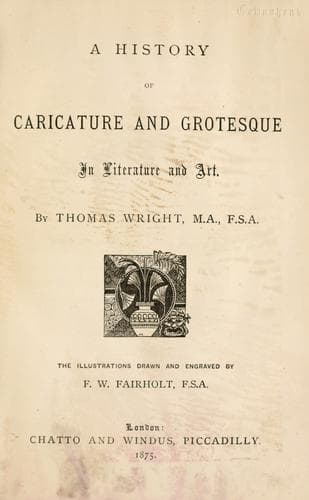
A History of Caricature and Grotesque in Literature and ArtWright, Thomas
History
A History of Caricature and Grotesque in Literature and Art
Wright, Thomas
Caricature -- History
It was Le Roy who drew up the first sketch of the "Satyre
Ménippée," each of the others executed his part in the composition, and
Pithou finally revised it. For several years this remarkable satire
circulated only secretly, and in manuscript, and it was not printed
until Henri IV. was established on the throne.
The satire opens with an account of the virtues of the "Catholicon,"
or nostrum for curing all political diseases, or the _higuiero
d'infierno_, which had been so effective in the hands of the Spaniards,
who invented it. Some of these are extraordinary enough. If, we are
told, the lieutenant of Don Philip "have some of this Catholicon on
his flags, he will enter without a blow into an enemy's country, and
they will meet him with crosses and banners, legates and primates; and
though he ruin, ravage, usurp, massacre, and sack everything, and carry
away, ravish, burn, and reduce everything to a desert, the people of
the country will say, 'These are our friends, they are good Catholics;
they do it for our peace, and for our mother holy church.'" "If an
indolent king amuse himself with refining this drug in his escurial,
let him write a word into Flanders to Father Ignatius, sealed with
the Catholicon, he will find him a man who (_salva conscientia_) will
assassinate his enemy whom he has not been able to conquer by arms in
twenty years." This, of course, is an allusion to the murder of the
prince of Orange. "If this king proposes to assure his estates to his
children after his death, and to invade another's kingdom at little
expense, let him write a word to Mendoza, his ambassador, or to Father
Commelet (one of the most seditious orators of the Ligue), and if he
write with the _higuiero del infierno_, at the bottom of his letter,
the words _Yo el Rey_, they will furnish him with an apostate monk, who
will go under a fair semblance, like a Judas, and assassinate in cold
blood a great king of France, his brother-in-law, in the middle of his
camp, without fear of God or men; they will do more, they will canonise
the murderer, and place this Judas above St. Peter, and baptise this
prodigious and horrible crime with the name of a providential event,
of which the godfathers will be cardinals, legates, and primates." The
allusion here is to the assassination of Henri III. by Jacques Clement.
These are but a few of the marvellous properties of the political drug,
after the enumeration of which the report of the meeting of the Estates
is introduced by a burlesque description of the grand procession
which preceded it. Then we are introduced to the hall of assembly, and
different subjects pictured on the tapestries which cover its walls,
all having reference to the politics of the Ligue, are described fully.
Then we come to the report of the meeting, and to the speeches of the
different speakers, each of which is a model of satire. It is not known
which of the little club of satirists wrote the open speech of the duke
Public-domain text, read in full here on John Shaqi.
Reviews
Reviews
No reviews yet
Be the first to share your thoughts on this work.
Elsewhere in the archive
Join the Discussion
Join the discussion
Sign in to leave a comment or review.
Sign InorCreate an account