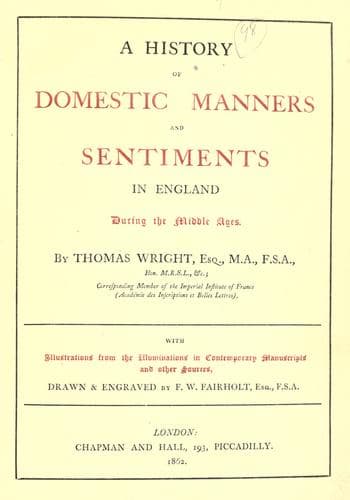
A History of Domestic Manners and Sentiments in England During the Middle AgesWright, Thomas
History
A History of Domestic Manners and Sentiments in England During the Middle Ages
Wright, Thomas
England -- Social life and customs -- 1066-1485
THE OLD ENGLISH HALL.--THE KITCHEN, AND ITS CIRCUMSTANCES.--THE
DINNER-TABLE.--MINSTRELSY.
As I have already stated, the hall continued to be the most important
part of the house; and in large mansions it was made of proportional
dimensions. It was a general place of rendezvous for the household,
especially for the retainers and followers, and in the evening it seems
usually to have been left entirely to them, and they made their beds
and passed the night in it. Strangers or visitors were brought into the
hall. In the curious old poem edited by Mr. Halliwell, entitled “The
Boke of Curtasye,” we find especial directions on this subject. When a
gentleman or yeoman came to the house of another, he was directed to
leave his weapons with the porter at the outward gate or wicket, before
he entered. It appears to have been the etiquette that if the person
thus presenting himself were of higher rank than the person he visited,
the latter should go out to receive him at the gate; if the contrary,
the visitor was admitted through the gate, and proceeded to the hall.
_Whanne thou comes to a lordis gate,_
_The porter thou shalle fynde therate;_
_Take_ (give) _hym thow shalt thy wepyn tho_ (then),
_And aske hym leve in to go._
* * * * *
... _yf he be of logh_ (low) _degré,_
_Than hym falles to come to the_.
At the hall door the visitor was to take off his hood and gloves--
_When thow come tho halle dor to,_
_Do of thy hode, thy gloves also._
If, when he entered the hall, the visitor found the family at meat, he
stood at the bottom of the apartment in a respectful attitude, till the
lord of the house sent a servant to lead him to a place where he was to
sit at table. As you descended lower in society, such ceremonies were
less observed; and the clergy in general seem to have been allowed a
much greater licence than the laity. In the Sompneres Tale, in Chaucer,
when the friar, who has received an insult from an inferior inhabitant,
goes “to the court” to complain to the lord of the village, he finds
the latter in his hall at the dinner table--
_This frere com, as he were in a rage,_
_Wher that this lord sat etyng at his bord._
--Chaucer’s Cant. Tales, l. 7748.
The lord, surprised at the agitation in the countenance of the friar,
who had come in without any sort of introduction, invites him to sit
down, and inquires into his business. There is a scene in the early
English metrical romance of Ipomydon, in which this hero and his
preceptor Tholoman go to the residence of the heiress of Calabria.
At the castle gate they were stopped by the porter, whom they ask to
announce them in the hall:--
Public-domain text, read in full here on John Shaqi.
Reviews
Reviews
No reviews yet
Be the first to share your thoughts on this work.
Elsewhere in the archive
Join the Discussion
Join the discussion
Sign in to leave a comment or review.
Sign InorCreate an account