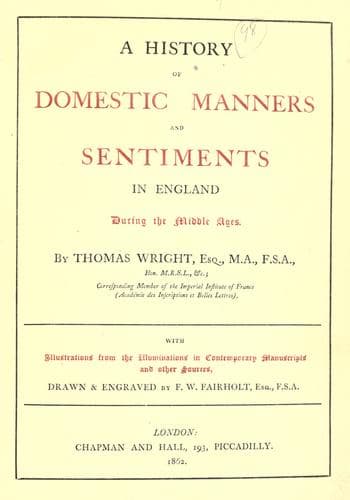
A History of Domestic Manners and Sentiments in England During the Middle AgesWright, Thomas
History
A History of Domestic Manners and Sentiments in England During the Middle Ages
Wright, Thomas
England -- Social life and customs -- 1066-1485
On the continent, when we first become acquainted with the history of
the popular literature, we find the minstrels, the representatives
of the ancient bards, appearing as the composers and chanters of the
poems which told the stories of the old heroes of romance, and they
seem also to have been accompanied usually with the harp, or with some
other stringed instrument. They speak of themselves, in these poems, as
wandering about from castle to castle, wherever any feasting was going
on, as being everywhere welcome, and as depending upon the liberality
either of the lord of the feast, or of the guests, for their living.
Occasional complaints would lead us to suppose that this liberality was
not always great, and the poems themselves contain formules of begging
appeals, which are not very dignified or delicate. Thus, in the romance
of “Gui de Bourgogne,” the minstrel interrupts his narrative, to inform
his hearers that “Whoever wishes to hear any more of this poem, must
make haste to open his purse, for it is now high time that he give me
something”--
_Qui or voldra chançon oïr et escouter,_
_Si voist isnelement sa boursse desfermer,_
_Qu’il est hui mès bien tans qu’il me doie doner._
--Gui de Bourgogne, l. 4136.
In like manner, in the romance of “Huon de Bordeaux,” the minstrel,
after having recited nearly five thousand lines, makes his excuse for
discontinuing until another day. He reminds his auditors that it is
near vespers, and that he is weary, and invites them to return next
day after dinner, begging each of them to bring with him a _maille_,
or halfpenny, and complaining of the meanness of those who were
accustomed to give so small a coin as the _poitivine_ “to the courteous
minstrel.” The minstrel seems to have calculated that this hint might
not be sufficient, and that they would require being reminded of it,
for, after some two or three hundred lines of the next day’s recital,
he introduces another formule of appeal to the purses of his hearers.
“Take notice,” he goes on to say, “as may God give me health, I will
immediately put a stop to my song; ... and I at once excommunicate all
those who shall not visit their purses in order to give something to my
wife”--
_Mais saciés bien, se Dix me doinst santé,_
_Ma cançon tost vous ferai desiner;_
_Tous chiaus escumenie_, ...
* * * * *
_Qui n’iront à lour bourses pour ma feme donner._
--Huon de Bordeaux, l. 5482.
These minstrels, too, display great jealousy of one another, and
especially of what they term the new minstrels, exclaiming against the
decadence of the profession.
Public-domain text, read in full here on John Shaqi.
Reviews
Reviews
No reviews yet
Be the first to share your thoughts on this work.
Elsewhere in the archive
Join the Discussion
Join the discussion
Sign in to leave a comment or review.
Sign InorCreate an account