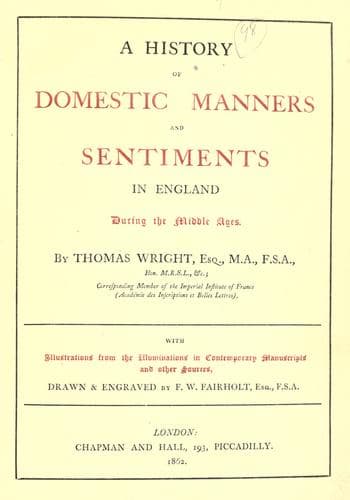
A History of Domestic Manners and Sentiments in England During the Middle AgesWright, Thomas
History
A History of Domestic Manners and Sentiments in England During the Middle Ages
Wright, Thomas
England -- Social life and customs -- 1066-1485
The character of the minstrels, or jougleurs, their wandering life,
and the ease with which they were admitted everywhere, caused them to
be employed extensively as spies, and as bearers of secret news, and
led people to adopt the disguise of a minstrel, as one which enabled
them to pass through difficulties unobserved and unchallenged. In
the story of Eustace the monk, when Eustace sought to escape from
England, to avoid the pursuit of king John, he took a fiddle and a
bow (a fiddlestick), and dressed himself as a minstrel, and in this
garb he arrived at the coast, and, finding a merchant ready to sail,
entered the ship with him. But the steersman, who did not recognise
the minstrel as one of the passengers, ordered him out. Eustace
expostulated, represented that he was a minstrel, and, after some
dispute, the steersman, who seems to have had some suspicions either
of his disguise or of his skill, concluded by putting the question,
“At all events, if thou knowest any song, friend, let us have it.”
The monk was not skilled in singing, but he replied boldly, “Know I
one? Yea! of Agoulant, and Aymon, or of Blonchadin, or of Florence of
Rome (these were all early metrical romances); there is not a song in
the whole world but I know it. I should be delighted, no doubt, to
afford you amusement; but, in truth, the sea frightens me so much at
present, that I could not sing a song worth hearing.” He was allowed
to pass. Some of those who adopted the disguise of the jougleur were
better able to sustain it, and minstrelsy became considered as a polite
accomplishment, perhaps partly on account of its utility. There is,
in the history of the Fitz-Warines, a remarkable character of this
description named John de Raunpaygne. Fulke Fitz-Warine had formed a
design against his great enemy, Moris Fitz-Roger, and he established
himself, with his fellow outlaws, in the forest near Whittington, in
Shropshire, to watch him. Fulke then called to him John de Raunpaygne.
“John,” said he, “you know enough of minstrelsy and joglery; dare
you go to Whittington, and play before Moris Fitz-Roger, and spy how
things are going on?” “Yea,” said John. He crushed a herb, and put it
in his mouth, and his face began immediately to swell, and became so
discoloured, that his own companions hardly knew him; and he dressed
himself in poor clothes, and “took his box with his instruments
of joglery and a great staff in his hand;” and thus he went to
Whittington, and presented himself at the castle, and said that he
was a jogeleur. The porter carried him to Sir Moris, who received him
well, inquired in the first place for news, and receiving intelligence
which pleased him (it was designedly false), he gave the minstrel a
valuable silver cup as a reward. Now, “John de Raunpaygne was very
ill-favoured in face and body, and on this account the ribalds of the
household made game of him, and treated him roughly, and pulled him by
his hair and by his feet.
Public-domain text, read in full here on John Shaqi.
Reviews
Reviews
No reviews yet
Be the first to share your thoughts on this work.
Elsewhere in the archive
Join the Discussion
Join the discussion
Sign in to leave a comment or review.
Sign InorCreate an account