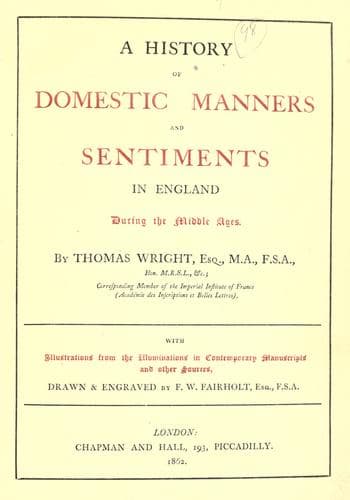
A History of Domestic Manners and Sentiments in England During the Middle AgesWright, Thomas
History
A History of Domestic Manners and Sentiments in England During the Middle Ages
Wright, Thomas
England -- Social life and customs -- 1066-1485
With the breaking up of feudalism, the game of chess seems to have gone
to a great extent out of practice, and made way for a comparatively
new game,--that of cards, which now became very popular. When Caxton
printed his “Boke of Chesse” in 1474, he sought only to publish a
moral treatise, and not to furnish his countrymen with a book of
instructions in the game. The cut of the chess-player given in this
book, copied in our cut No. 148, shows some modifications in the forms
of the chess-men. The knight, the rook, and the pawn, have preserved
their old forms; but we are led to suppose, by the number of pieces
with the bi-partite head, that the bishop had assumed a shape nearly
resembling that of the rook. We have just seen Chaucer alluding to one
of the legends relating to the origin of this game. Caxton, after Jean
de Vignay and Jacques de Cessoles, gives us a strange story how it was
invented under Evylmerodach, king of Babylon, by a philosopher, “whyche
was named in Caldee Exerses, or in Greke Philemetor.”
[Illustration: _No. 148. Chess in the Fifteenth Century._]
[Illustration: _No. 149. An Italian Chess-board._]
Meanwhile, the game of chess had continued to flourish in Italy, where
it appears to have experienced improvements, and where certainly the
forms of the men were considerably modified. An Italian version of the
work of Jacques de Cessoles was printed at Florence in 1493, under the
title of _Libro de Giuocho delli Scacchi_, among the engravings to
which, as in most of the editions of that work, there is a picture of
a group of chess-players, who are here seated at a round table. The
chess-board is represented in our cut, No. 149, and it will be seen at
a glance that the chess-men present a far greater resemblance to those
used at the present day than those given in the older illuminations.
Within a few years of the date of this book, a Portuguese, named
Damiano, who was perhaps residing in Italy, as his work seems to have
appeared there first, drew up a book of directions for chess with a
set of eighty-eight games, which display considerable ingenuity. An
edition of this book was published at Rome as early as 1524, and
perhaps this was not the first. The figures of the chess-men are given
in this treatise; that of the king is vase-shaped, not unlike our
modern chess-king, but with two crowns; the queen is similar in shape,
but has one crown; the _delfino_ (bishop) differs from them in being
smaller, and having no crown; the _cavallo_ (knight) has the form of
a horse’s head; the _rocho_, as it is still called, is in the form of
a tower, like our modern castle; and the _pedona_ (pawn) resembles a
cone, with a knob at the apex. In England, the game of chess seems
not to have been much in vogue during the sixteenth century; it is, I
believe, only alluded to once in Shakespeare, in a well-known scene
in the Tempest, which may have been taken from a foreign story, to
which he owed his plot. The name of the game had been corrupted into
Public-domain text, read in full here on John Shaqi.
Reviews
Reviews
No reviews yet
Be the first to share your thoughts on this work.
Elsewhere in the archive
Join the Discussion
Join the discussion
Sign in to leave a comment or review.
Sign InorCreate an account