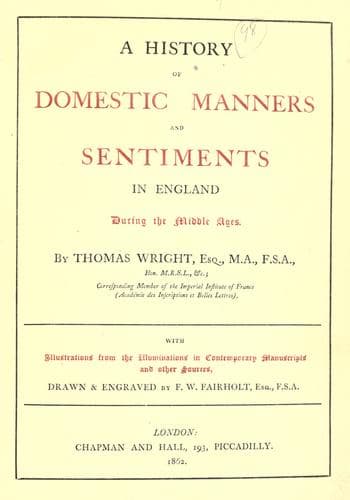
A History of Domestic Manners and Sentiments in England During the Middle AgesWright, Thomas
History
A History of Domestic Manners and Sentiments in England During the Middle Ages
Wright, Thomas
England -- Social life and customs -- 1066-1485
It must not be forgotten that it is partly to the use of playing cards
that we owe the invention which has been justly regarded as one of the
greatest benefits granted to mankind. The first cards, as we have seen,
were painted with the hand. They were subsequently made more rapidly
by a process called stencilling--that is, by cutting the rude forms
through a piece of pasteboard, parchment, or thin metal, which, placed
on the cardboard intended to receive the impression, was brushed
over with ink or colour, which passed through the cut out lines, and
imparted the figure to the material beneath. A further improvement was
made by cutting the figures on blocks of wood, and literally printing
them on the cards. These card-blocks are supposed to have given the
first idea of wood-engraving. When people saw the effects of cutting
the figures of the cards upon blocks, they began to cut figures of
saints on blocks in the same manner, and then applied the method to
other subjects, cutting in like manner the few words of necessary
explanation. This practice further expanded itself into what are called
block-books, consisting of pictorial subjects, with copious explanatory
text. Some one at length hit upon the idea of cutting the pages of
a regular book on so many blocks of wood, and taking impressions on
paper or vellum, instead of writing the manuscript; and this plan was
soon further improved by cutting letters or words on separate pieces
of wood, and setting them up together to form pages. The wood was
subsequently superseded by metal. And thus originated the noble art of
PRINTING.
CHAPTER XI.
DOMESTIC AMUSEMENTS AFTER DINNER.--THE CHAMBER AND ITS
FURNITURE.--PET ANIMALS.--OCCUPATIONS AND MANNERS OF THE
LADIES.--SUPPER.--CANDLES, LAMPS, AND LANTERNS.
When the dinner was over, and hands washed, a drink was served round,
and then the ladies left the table, and went to their chambers or to
the garden or fields, to seek their own amusements, which consisted
frequently of dancing, in which they were often joined by the younger
of the male portion of the household, while the others remained
drinking. They seem often to have gone to drink in another apartment,
or secondary hall, perhaps in the parlour. In the romance of “La
Violette” (p. 159), we read of the father of a family going to sleep
after dinner. In the same romance (p. 152), the young ladies and
gentlemen of a noble household are described as spreading themselves
over the castle, to amuse themselves, attended by minstrels with music.
From other romances we find that this amusement consisted often in
dancing, and that the ladies sometimes sang for themselves, instead of
having minstrels. We find these amusements alluded to in the fabliaux
and romances of the thirteenth and fourteenth centuries. In one of the
fabliaux, a knight having been received hospitably at a feudal castle,
after dinner they wash, and drink round, and then they go to dance--
Public-domain text, read in full here on John Shaqi.
Reviews
Reviews
No reviews yet
Be the first to share your thoughts on this work.
Elsewhere in the archive
Join the Discussion
Join the discussion
Sign in to leave a comment or review.
Sign InorCreate an account