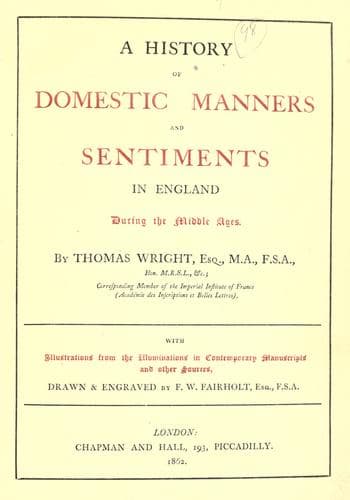
A History of Domestic Manners and Sentiments in England During the Middle AgesWright, Thomas
History
A History of Domestic Manners and Sentiments in England During the Middle Ages
Wright, Thomas
England -- Social life and customs -- 1066-1485
ring of sir Perceval of Galles (Thornton Romances, p. 71) at all less
remarkable in its properties, of which the rhymer says--
_Siche a vertue es in the stane,_
_In alle this werlde wote I nane_
_Siche stone in a rynge;_
_A mane that had it in were_ (war)
_One his body for to bere,_
_There scholde no dyntys_ (blows) _hym dere_ (injure),
_Ne to dethe brynge_.
The consideration of the house and its parts and furniture, and of
the outward forms of domestic life, leads us naturally to that of the
constitution of the family. It was the chief pride of the aristocratic
class to live very extravagantly, and to support a great household,
with an immense number of personal attendants of different classes.
In the first place the old system of fostering, which was kept up to
a comparatively late period, added to the number of the lord’s or
knight’s family. As might was literally right in the middle ages,
each man of worth sought to strengthen himself by the alliances which
were formed by finding powerful foster-fathers for his sons, and the
personal attachment and fidelity between the chief of the family and
his foster-child was often greater even than that between the father
and his own son. In addition to the foster children, gentlemen sent
their sons to take an honourable kind of service in the families of men
of higher rank or greater wealth, where the manners and accomplishments
of gentlemen were to be learnt in greater perfection than at home;
and the younger sons of great families sought similar service with
a view to their advancement in the world. These two classes were the
young squires, who served at table, and performed a great number of
what we should now call menial offices to the lord and ladies of the
household, in all the amusements and recreations of which they took
part, and at the same time were instructed in gentlemanly manners and
exercises--it was a sort of apprenticeship introductory to knighthood.
In the same manner the knightly families sent their daughters to serve
under the ladies of the greater or lesser feudal chieftains, and they
formed that class who, in the French romances and fabliaux, are called
the _chambrières_, or chamber attendants, and in the English texts,
simply the _maidens_, of the establishment. The ladies of rank prided
themselves upon having a very great number of these _chambrières_,
or maidens, for they were not only a means of ostentation, but they
were profitable, inasmuch as besides attending on the personal wants
of their mistresses, they were constantly employed in spinning,
weaving, and the various processes of producing cloth, in millinery and
dress-making, in embroidery, and in a great number of similar labours,
which were not only required for furnishing the large number of persons
who depended upon their lord for their liveries, &c., but which were
sometimes sold to obtain money, which was always a scarce thing in the
country.
Public-domain text, read in full here on John Shaqi.
Reviews
Reviews
No reviews yet
Be the first to share your thoughts on this work.
Elsewhere in the archive
Join the Discussion
Join the discussion
Sign in to leave a comment or review.
Sign InorCreate an account