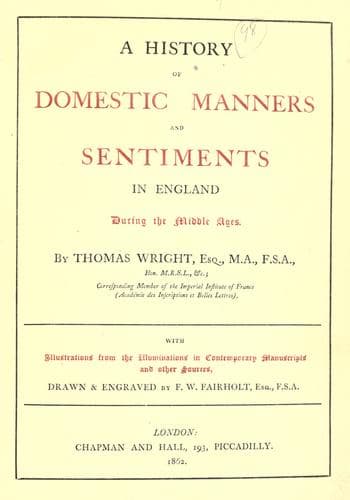
A History of Domestic Manners and Sentiments in England During the Middle AgesWright, Thomas
History
A History of Domestic Manners and Sentiments in England During the Middle Ages
Wright, Thomas
England -- Social life and customs -- 1066-1485
Great importance was placed in the breeding of horses in the middle
ages. Charlemagne, in the regulations for the administration of his
private domains, gives particular directions for the care of his
brood-mares and stallions. Normandy appears to have been famous for its
studs of horses in the eleventh and twelfth centuries, and documents
show that the monks took good care rigorously to exact the tithes of
their produce to stock the monastic stables. Traces of the existence
of similar studs are found also in other parts of France. At this time
a horse was considered the handsomest present that could be made by
a king or a great lord, and horses were often given as bribes. Thus,
in 1227, the monks of the abbey of Troarn obtained from Guillaume
de Tilli the ratification of a grant made to them by his father in
consideration of a gift to him of a mark of silver and a palfrey; and
the monks of St. Evroul, in 1165, purchased a favour of the English
earl of Gloucester by presenting to him two palfreys estimated to be
worth twenty pounds of money of Anjou. Kings frequently received horses
as presents from their subjects. The widow of Herbert du Mesnil gave
king John of England a palfrey to obtain the wardship of her children;
and one Geoffrey Fitz-Richard gave the same monarch a palfrey for a
concession in the forest of Beaulieu. In 1172, Raimond, count of St.
Gilles, having become the vassal of the king of England, engaged to pay
him an annual tribute of a hundred marks of silver, or ten _dextriers_,
worth at least ten marks each. The English studs appear already in the
thirteenth century to have become remarkable for their excellence.
Travelling, in the middle ages, was assisted by few, it any,
conveniences, and was dangerous as well as difficult. The insecurity
of the roads made it necessary for travellers to associate together
for protection, as well as for company, for their journeys were slow
and dull; and as they were often obliged to halt for the night where
there was little or no accommodation, they had to carry a good deal
of luggage. An inn was often the place of rendezvous for travellers
starting upon the same journey. It is thus that Chaucer represents
himself as having taken up his quarters at the Tabard, in Southwark,
preparatory to undertaking the journey to Canterbury; and at night
there arrived a company of travellers bent to the same destination,
who had gathered together as they came along the road:--
_At night was come into that hostelrie_
_Wel nyne and twenty in a companye,_
_Of sondry folk, by aventure ifalle_
_In felaschipe._
--Cant. Tales, l. 23.
Public-domain text, read in full here on John Shaqi.
Reviews
Reviews
No reviews yet
Be the first to share your thoughts on this work.
Elsewhere in the archive
Join the Discussion
Join the discussion
Sign in to leave a comment or review.
Sign InorCreate an account