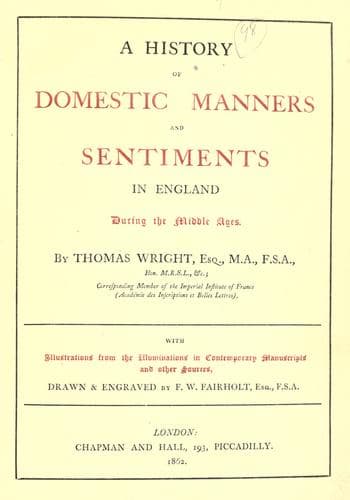
A History of Domestic Manners and Sentiments in England During the Middle AgesWright, Thomas
History
A History of Domestic Manners and Sentiments in England During the Middle Ages
Wright, Thomas
England -- Social life and customs -- 1066-1485
The tavern in the middle ages seems to have been the usual scene of a
large portion of the ordinary life of the lower class of society, and
even partially of the middle class, and its influence was certainly
very injurious on the manners and character of the people. Even the
women, as we learn from a number of contemporary songs and stories,
spent much of their time drinking and gossiping in taverns, where great
latitude was afforded for carrying on low intrigues. The tavern was, in
fact, the general rendezvous of those who sought amusement, of whatever
kind. In the “Milleres Tale,” in Chaucer, Absolon, “that joly was
and gay,” and who excelled as a musician, frequented the taverns and
“brewhouses,” meaning apparently the lesser public-houses where they
only sold ale, to exhibit his skill--
_In al the toun nas brewhous ne taverne_
_That he ne visited with his solas,_
_Ther as that any gaylard tapster was._
--Cant. Tales, l. 3,334.
And Chaucer’s friar was well acquainted with all the taverns in the
towns he visited--
_He knew wel the tavernes in every toun,_
_And every osteller or gay tapstere._
--Ibid., l. 240.
The tavern was especially the haunt of gamblers, who were encouraged by
the “tapster,” because they brought him his most profitable customers.
As I have said before, when his customers had no money, the taverner
took their articles of dress for payment, and in doing this he added
the profits of the money-lender to those of the taverner. In the
fabliau of “Gautier d’Aupais,” the young prodigal Gautier, hungry and
penniless, arrives towards evening at a tavern, where he finds a number
of guests enjoying themselves. His horse is taken to the stable, and
he joins the guests, but when the moment comes for paying, and the
taverner demands three sols, he is induced in his desperation to try
his luck at the dice. Instead, however, of retrieving his fortunes, he
loses his horse and his robe, and is obliged to return to his father’s
house on foot, and in his shirt--
_Si a perdu sa robe et son corant destrier;_
_En pure sa chemise l’en convint reperier._
Public-domain text, read in full here on John Shaqi.
Reviews
Reviews
No reviews yet
Be the first to share your thoughts on this work.
Elsewhere in the archive
Join the Discussion
Join the discussion
Sign in to leave a comment or review.
Sign InorCreate an account