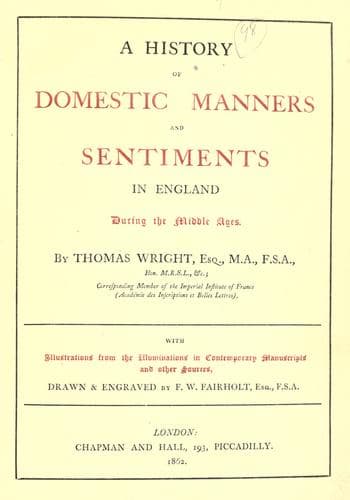
A History of Domestic Manners and Sentiments in England During the Middle AgesWright, Thomas
History
A History of Domestic Manners and Sentiments in England During the Middle Ages
Wright, Thomas
England -- Social life and customs -- 1066-1485
During the thirteenth and fourteenth centuries, there was certainly a
general feeling of the necessity of extending and improving education.
It was during this period that our great universities rose into
existence, and flourished, and these schools, which provided for the
higher development of the mind, had their thousands of students,
instead of the hundreds who frequent them at the present day. But the
need of some provision for education was felt most in regard to that
less elevated degree of instruction which was required for the more
youthful mind,--in fact, it was long before the people of the middle
ages could be persuaded that literary education was of any use at
all, except for those who were to be made great scholars; the clergy
itself, unfortunately, did not see the necessity of popular education,
and although the schools in parish churches were long continued, they
appear to have been conducted more and more with negligence. It was the
mercantile class in the towns which made the first step in advance,
by the establishment of those foundations which have continued to the
present time under the name of grammar schools. These schools are
traced back to the thirteenth century, when the merchant guilds, by
whom they were founded, began to assume a greater degree of importance,
and they were usually intended for the general benefit of the town,
but were combined with an ecclesiastical establishment for performing
services for the souls of the members of the guilds, in consequence of
which, at the Reformation, they became involved in the superstitious
uses, and were dissolved and refounded in the reign of Edward VI., so
that they are now generally known as king Edward’s foundations. The
great object of these schools was to give the instruction necessary
for admission into the universities; and they were in some degree the
answer to an appeal which came deeply from the mass of the people,--for
there was at this time a great spontaneous eagerness for learning, both
for the sake of the learning itself, and because it was a road to high
distinction, which was not open to the masses in any other direction.
It was a very common practice for poor youths to go about the country
during vacation time, to beg money to keep them at school during term.
In Piers Ploughman, among the objects of legitimate charity, the writer
enumerates money given to--
_Sette scolers to scole,_
_Or to som othere craftes._
--Piers Ploughman, Vis., l. 4,525.
And in the popular complaints of the burden of taxation, involuntary
and voluntary, the alms given to poor scholars are often enumerated.
[Illustration: _No. 227. A Monk at his Studies._]
Public-domain text, read in full here on John Shaqi.
Reviews
Reviews
No reviews yet
Be the first to share your thoughts on this work.
Elsewhere in the archive
Join the Discussion
Join the discussion
Sign in to leave a comment or review.
Sign InorCreate an account