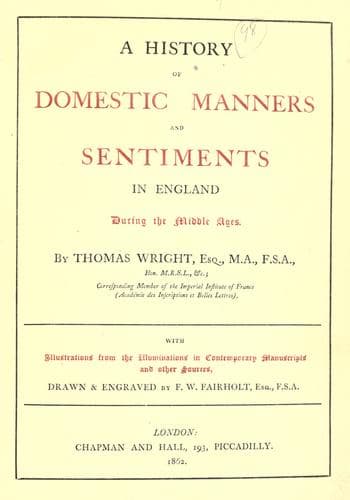
A History of Domestic Manners and Sentiments in England During the Middle AgesWright, Thomas
History
A History of Domestic Manners and Sentiments in England During the Middle Ages
Wright, Thomas
England -- Social life and customs -- 1066-1485
But although we have abundant evidence of the general fact that our
Norman and English forefathers loved the table, we have but imperfect
information on the character of their cookery until the latter half of
the fourteenth century, when the rules and receipts for cooking appear
to have been very generally committed to writing, and a certain number
of cookery-books belonging to this period and to the following century
remain in manuscript, forming very curious records of the domestic
life of our forefathers. From these I will give a few illustrations of
this subject. These cookery-books sometimes contain plans for dinners
of different descriptions, or, as we should now say, bills of fare,
which enable us, by comparing the names of the dishes with the receipts
for making them, to form a tolerably distinct notion of the manner in
which our forefathers fared at table from four to five hundred years
ago. The first example we shall give is furnished by a manuscript of
the beginning of the fifteenth century, and belongs to the latter
part of the century preceding; that is, to the reign of Richard II.,
a period remarkable for the fashion for luxurious living: it gives
us the following bill of fare for the ordinary table of a gentleman,
which I will arrange in the form of a bill of fare of the present day,
modernizing the language, except in the case of obsolete words.
_First Course._
Boar’s head enarmed (_larded_), and “bruce,” for pottage.
Beef. Mutton. Pestles (_legs_) of Pork.
Swan. Roasted Rabbit. Tart.
_Second Course._
Drope and Rose, for pottage.
Mallard. Pheasant. Chickens, “farsed” and roasted.
“Malachis,” baked.
_Third Course._
Conings (_rabbits_), in gravy, and hare, in “brasé,” for pottage.
Teals, roasted. Woodcocks. Snipes.
“Raffyolys,” baked. “Flampoyntes.”
It may be well to make the general remark, that the ordinary number
of courses at dinner was three. To begin, then, with the first dish,
boar’s-head was a favourite article at table, and needs no explanation.
The pottage which follows, under the name of _bruce_, was made as
follows, according to a receipt in the same cookery-book which has
furnished the bill of fare:--
Take the umbles of a swine, and parboil them (_boil them slowly_),
and cut them small, and put them in a pot, with some good broth;
then take the whites of leeks, and slit them, and cut them small,
and put them in, with minced onions, and let it all boil; next take
bread steeped in broth, and “draw it up” with blood and vinegar,
and put it into a pot, with pepper and cloves, and let it boil; and
serve all this together.
In the second course, _drope_ is probably an error for _drore_, a
pottage, which, according to the same cookery-book, was made as
follows:--
Public-domain text, read in full here on John Shaqi.
Reviews
Reviews
No reviews yet
Be the first to share your thoughts on this work.
Elsewhere in the archive
Join the Discussion
Join the discussion
Sign in to leave a comment or review.
Sign InorCreate an account