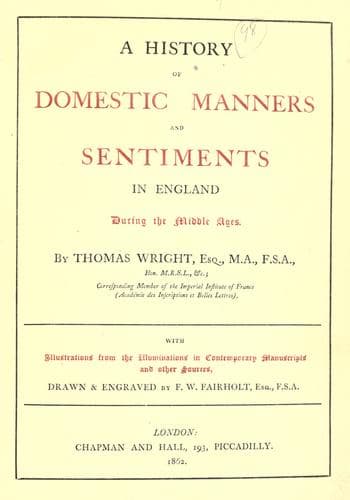
A History of Domestic Manners and Sentiments in England During the Middle AgesWright, Thomas
History
A History of Domestic Manners and Sentiments in England During the Middle Ages
Wright, Thomas
England -- Social life and customs -- 1066-1485
The progress of society in the two countries which were most closely
allied in this respect, England and France, was slow during the
fifteenth century. Both countries were engaged either in mutual
hostility or in desolating civil wars, which so utterly checked all
spirit of improvement, that the aspect of society differed little
between the beginning and the end of the century in anything but dress.
At the close of the fourteenth century, the middle classes in England
had made great advance in wealth and in independence, and the wars of
the roses, which were so destructive to the nobility, as well as the
tendency of the crown to set the gentry up as a balance to the power of
the feudal barons, helped to make that advance more certain and rapid.
This increase of wealth appears in the multiplication of furniture and
of other household implements, especially those of a more valuable
description. We are surprised, in running our eye through the wills
and inventories during this period, at the quantity of plate which
was usually possessed by country gentlemen and respectable burghers.
There was also a great increase both in the number and magnitude of the
houses which intervened between the castle and the cottage. Instead of
having one or two bedrooms, and turning people into the hall to sleep
at night, we now find whole suits of chambers; while, where before, the
family lived chiefly in the hall, privacy was sought by the addition
of parlours, of which there were often more than one in an ordinary
sized house. The hall was in fact already beginning to diminish in
importance in comparison with the rest of the house. Whether in town
or country, houses of any magnitude were now generally built round an
interior court, into which the rooms almost invariably looked, only
small and unimportant windows looking towards the street or country.
This arrangement of course originated in the necessity of studying
security, a necessity which was never felt more than in the fifteenth
century. We have less need to seek our illustrations from manuscripts
during this period, on account of the numerous examples of buildings
which still remain in a greater or less state of perfection, but still
an illumination now and then presents us with an interesting picture
of the architectural arrangements of a dwelling-house in the fifteenth
century, which may be advantageously compared with the buildings that
still exist. One of these is represented in our cut No. 234, taken from
an illuminated copy of the French translation of Valerius Maximus (MS.
No. 6984, in the National Library at Paris). The building to the left
is probably the staircase turret of the gateway; that before us is the
mass of the household apartments. We are supposed to be standing within
the court. At the foot of the turret is the well, a very important
object within the court, where it was always placed in houses of this
description, as in the troubles of those days the household might be
Public-domain text, read in full here on John Shaqi.
Reviews
Reviews
No reviews yet
Be the first to share your thoughts on this work.
Elsewhere in the archive
Join the Discussion
Join the discussion
Sign in to leave a comment or review.
Sign InorCreate an account