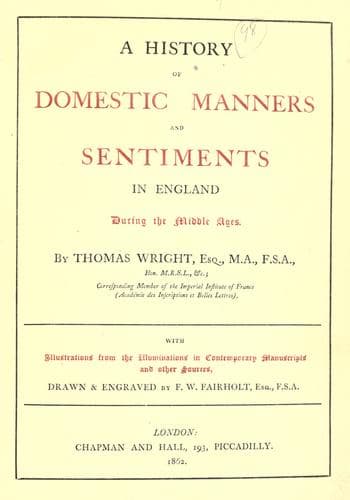
A History of Domestic Manners and Sentiments in England During the Middle AgesWright, Thomas
History
A History of Domestic Manners and Sentiments in England During the Middle Ages
Wright, Thomas
England -- Social life and customs -- 1066-1485
The female part of the family now passed in the parlour much of the
time which had been formerly passed in their chambers. It was often
their place of work. Young ladies, even of great families, were
brought up not only strictly, but even tyrannically, by their mothers,
who kept them constantly at work, exacted from them almost slavish
deference and respect, and even counted upon their earnings. The
parental authority was indeed carried to an almost extravagant extent.
There are some curious instances of this in the correspondence of
the Paston family. Agnes Paston, the wife of sir William Paston, the
judge, appears to have been a very harsh mother. At the end of June
1454, Elizabeth Clere, a kinswoman who appears to have lived in great
intimacy with the family, sent to John Paston, the lady’s eldest son,
the following account of the treatment of his sister Elizabeth, who
was of marriageable age, and for whom a man of the name of Scroope
had been proposed as a husband. “Therefore, cousin,” writes Jane
Clere, “meseemeth he were go for my cousin your sister, without that
ye might get her a better; and if ye can get a better, I would advise
you to labour it in as short time as ye may goodly, for she was never
in so great a sorrow as she is now-a-days, for she may not speak
with no man, whosoever come, nor even may see nor speak with my man,
nor with servants of her mother’s, but that she beareth her on hand
otherwise than she meaneth; and she hath since Easter the most part
been beaten once in the week, or twice, and sometimes twice in a day,
and her head broken in two or three places. Wherefore, cousin, she
hath sent to me by friar Newton in great counsel, and prayeth me that
I would send to you a letter of her heaviness, and pray you to be her
good brother, as her trust is in you.” In spite of her anxiety to be
married, Elizabeth Paston did not succeed at this time, but she was
soon afterwards transferred from her paternal roof to the household of
the lady Pole. It was still the custom to send young ladies of family
to the houses of the great to learn manners, and it was not only a
matter of pride and ostentation to be thus surrounded by a numerous
train, but the noble lady whom they served did not disdain to receive
payment for their board as well as employing them in profitable work.
In a memorandum of errands to London, written by Agnes Paston on the
28th of January, 1457, one is a message to “Elizabeth Paston that she
must use herself to work readily, as other gentlewomen do, and somewhat
to help herself therewith. Item, to pay the lady Pole twenty-six
shillings and eightpence for her board.” Margaret Paston, the wife of
John Paston, just mentioned, and daughter-in-law of Agnes, seems to
have been equally strict with her daughters. At the beginning of the
reign of Edward IV., she wrote to her son John concerning his sister
Anne, who had been placed in the house of a kinsman of the name of
Calthorpe.
Public-domain text, read in full here on John Shaqi.
Reviews
Reviews
No reviews yet
Be the first to share your thoughts on this work.
Elsewhere in the archive
Join the Discussion
Join the discussion
Sign in to leave a comment or review.
Sign InorCreate an account