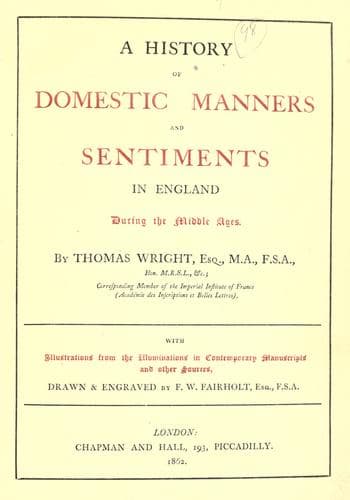
A History of Domestic Manners and Sentiments in England During the Middle AgesWright, Thomas
History
A History of Domestic Manners and Sentiments in England During the Middle Ages
Wright, Thomas
England -- Social life and customs -- 1066-1485
The remaining portions of the tapestry represent the attack of the
Diseases, and the great havoc they made among the guests.
The banquet was known in England by that name, as well as by the
name of rere-supper. In the curious English morality play, entitled
“The Interlude of the Four Elements,” printed early in the sixteenth
century, the same distinction is made between the three meals as in
the French morality described above. Sensual-appetite, one of the
characters in the piece, leads Humanity to the tavern to dine, and
orders a dinner of three courses, with a choice variety of wines. As
they are leaving after dinner, the taverner reminds them that they
were to return to supper; and then Humanity proposes a cup of “new”
wine, as though wine was then valued for being new. Food and liquor
were formerly adulterated in more dishonest manner even than in modern
times, and the taverner answers the demand jokingly--
_Ye shall have wyne as newe as can be,_
_For I may tell you in pryvyté_
_Hit was brued but yester nyght._
But he immediately adds--
_But than I have for your apetyte_
_A cup of wyne of olde claret;_
_There is no better, by this lyght._
After supper they go to dance, and meanwhile Sensual-appetite goes to
prepare the banquet:--
_I shall at the towne agayne_
_Prepare for you a banket,_
_Of metys that be most delycate,_
_And most pleasaunt drynkes and wynes therate,_
_That is possyble to get._
_Which shall be in a chamber feyre_
_Preparyd poynt devyse_ (in perfection),
_With damaske water made so well_
_That all the howse thereof shall smell_
_As it were Paradyse_.
In “Acolastus,” a work by the grammarian Palsgrave, published in 1540,
the banquet is still identified with the rere-supper, when he speaks
of “the rere-supper, or banket, where men syt downe to drynke and eate
agayne after their meate.” And again, still later, Higins, in his
“Nomenclator,” published in 1585, explains the Latin word _pocœnium_ by
“a reare-supper, or a banket after supper.” The term rere-supper was
in use throughout the fifteenth century. An English vocabulary of that
century speaks of a meal between dinner and supper, under the name of
“a myd-dyner under-mete,” the same which, no doubt, was called by a
French word, a _bever_, as consisting especially in taking a drink, and
which, removed to the time between breakfast and dinner, is now called
a luncheon.
In the introduction to Lydgate’s “Story of Thebes,” which is introduced
as a continuation of the “Canterbury Tales,” the poet pretends to have
arrived at the inn in Canterbury when it was occupied by the pilgrims,
who invite him to sup with them, and he joins their company. “Our
host,” who is the leader of the pilgrims, offers him his place at their
supper heartily:
Public-domain text, read in full here on John Shaqi.
Reviews
Reviews
No reviews yet
Be the first to share your thoughts on this work.
Elsewhere in the archive
Join the Discussion
Join the discussion
Sign in to leave a comment or review.
Sign InorCreate an account