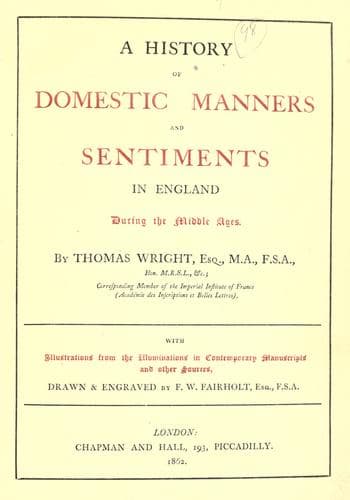
A History of Domestic Manners and Sentiments in England During the Middle AgesWright, Thomas
History
A History of Domestic Manners and Sentiments in England During the Middle Ages
Wright, Thomas
England -- Social life and customs -- 1066-1485
Whatever moderation the Normans may have brought with them, or however
they may have been restrained by the first Anglo-Norman monarch, it
disappeared entirely under his son and successor: “when,” in the words
of William of Malmesbury, “everything was so changed, that there was
no man rich except the money-changer, and no clerks but lawyers....
The courtiers then preyed upon the property of the country people, and
consumed their substance, taking the very meat from their mouths. Then
was there flowing hair and extravagant dress; and then was invented
the fashion of shoes with curved points; then the model for young men
was to rival women in delicacy of person, to mince their gait, to walk
with loose gesture, and half naked.” This increasing dissoluteness of
manners appears to have received no effectual check under the reign of
the first Henry; in the twenty-ninth year of which, the writer just
quoted tells us that “a circumstance occurred in England, which may
seem surprising to our long-haired gallants, who, forgetting what they
were born, transform themselves into the fashion of females, by the
length of their locks. A certain English knight, who prided himself on
the luxuriance of his tresses, being conscience-stung on the subject,
seemed to feel in a dream as though some person strangled him with
his ringlets. Awaking in a fright, he immediately cut off all his
superfluous hair. The example spread throughout England; and, as recent
punishment is apt to affect the mind, almost all the barons allowed
their hair to be cropped in a proper manner, without reluctance. But
this decency was not of long continuance; for scarcely had a year
expired, before all those who thought themselves courtly, relapsed
into their former vice; they vied with women in length of locks, and
wherever these were wanting, put on false tresses; forgetful, or rather
ignorant, of the saying of the Apostle, ‘If a man nurture his hair, it
is a shame to him.’” Public and private manners were gradually running
into the terrible lawlessness of the reign of king Stephen.
Public-domain text, read in full here on John Shaqi.
Reviews
Reviews
No reviews yet
Be the first to share your thoughts on this work.
Elsewhere in the archive
Join the Discussion
Join the discussion
Sign in to leave a comment or review.
Sign InorCreate an account