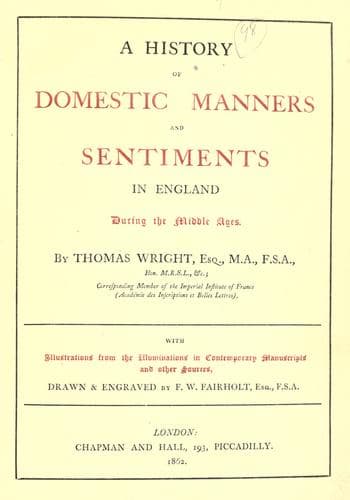
A History of Domestic Manners and Sentiments in England During the Middle AgesWright, Thomas
History
A History of Domestic Manners and Sentiments in England During the Middle Ages
Wright, Thomas
England -- Social life and customs -- 1066-1485
Alexander Neckam has left us a sufficiently clear description of the
Norman hall. He says that it had a vestibule or screen (_vestibulum_),
and was entered through a porch (_porticus_), and that it had a court,
the Latin name of which (_atrium_) he pretends was derived from _ater_
(black), “because the kitchens used to be placed by the side of the
streets, in order that the passers-by might perceive the smell of
cooking.” This explanation is so mysterious, that we may suppose the
passage to be corrupt, but the _coquinæ_ of which Neckam is speaking
are evidently cook’s shops. In the interior of the hall, he says, there
were posts (or columns) placed at regular distances. The few examples
of Norman halls which remain are divided internally by two rows of
columns. Neckam enumerates the materials required in the construction
of the hall, which seem to show that he is speaking of a timber
building. A fine example of a timber hall, though of a later period,
is, or was recently, standing in the city of Gloucester, with its
internal “posts” as here described. There appears also to have been an
inner court-yard, in which Neckam intimates that poultry were kept. The
whole building, and the two court-yards, were no doubt surrounded by a
wall, outside of which were the garden and orchard. The Normans appear
to have had a taste for gardens, which formed a very important adjunct
to the mansion, and to the castle, and are not unfrequently alluded to
in mediæval writers, even as far back as the twelfth century. Giraldus
Cambrensis, speaking of the castle of Manorbeer (his birthplace), near
Pembroke, said that it had under its walls, besides a fine fish-pond,
“a beautiful garden, inclosed on one side by a vineyard, and on the
other by a wood, remarkable for the projection of its rocks, and the
height of its hazel-trees.” In the twelfth century, vineyards were not
uncommon in England.
[Illustration: _No. 70. A Man warming himself._]
Public-domain text, read in full here on John Shaqi.
Reviews
Reviews
No reviews yet
Be the first to share your thoughts on this work.
Elsewhere in the archive
Join the Discussion
Join the discussion
Sign in to leave a comment or review.
Sign InorCreate an account