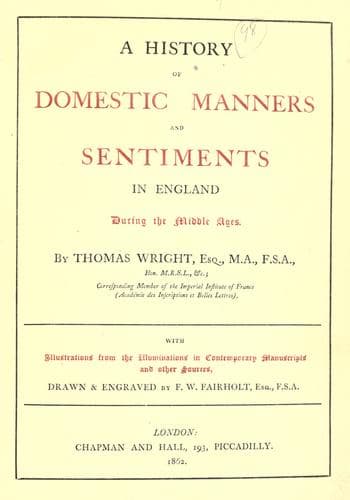
A History of Domestic Manners and Sentiments in England During the Middle AgesWright, Thomas
History
A History of Domestic Manners and Sentiments in England During the Middle Ages
Wright, Thomas
England -- Social life and customs -- 1066-1485
After the entrance of the Normans, we begin to find more frequent
allusions to the convivial meetings of the middle and lower orders in
ordinary inns or private houses. Thus, we have a story in Reginald
of Durham, of a party of the parishioners of Kellow, who went to a
drinking party at the priest’s, and passed in this manner a great
portion of the night.[22] This occurred in the time of bishop Geoffrey
Rufus, between 1133 and 1140. A youth and his monastic teacher are
represented on another occasion as going to a tavern, and passing the
whole of the night in drinking, till one of them becomes inebriated,
and cannot be prevailed on to return home. Another of Reginald’s
stories describes a party in a private house, sitting and drinking
round the fire. We are obliged thus to collect together slight and
often trivial allusions to the manners of a period during which we have
so few detailed descriptions. Hospitality was at this time exercised
among all classes freely and liberally; the misery of the age made
people meet together with more kindliness. The monasteries had their
open guest-houses, and the unknown traveller was seldom refused a
place at the table of the yeoman. In towns, most of the burgesses or
citizens were in the habit of receiving strangers as private lodgers,
in addition to the accommodation afforded in the regular _hospitia_
or taverns. Travelling, indeed, was more usual under the Normans than
it had been under the Saxons, for it was facilitated by the more
extensive use of horses. But this also brought serious evils upon the
country; for troops of followers and rude retainers who attended on
the proud and tyrannical aristocracy, were in the habit of taking up
their lodgings at will and discretion, and living upon the unfortunate
householders without pay. It had been, even during the Anglo-Saxon
period, a matter of pride and ostentation among men of rank--especially
the king’s officers--to travel about accompanied with a great multitude
of followers,[23] and this practice certainly did not diminish under
the Normans. But, whether in great numbers or in small, the travellers
of the twelfth century sought the means of amusing themselves during
their journey, and these amusements resembled some of those which were
employed at the dinner-table--they told stories, or repeated episodes
from romances, or sung, and they sometimes had minstrels to accompany
them. In the romance of Huon de Bordeaux, Huon, on his journey from his
native city to Paris, asks his brother Gerard to sing, to enliven them
on the road,--
_Cante, biau frere, pour nos cors esjoir._--Huon de Bordeaux, p. 18.
Public-domain text, read in full here on John Shaqi.
Reviews
Reviews
No reviews yet
Be the first to share your thoughts on this work.
Elsewhere in the archive
Join the Discussion
Join the discussion
Sign in to leave a comment or review.
Sign InorCreate an account