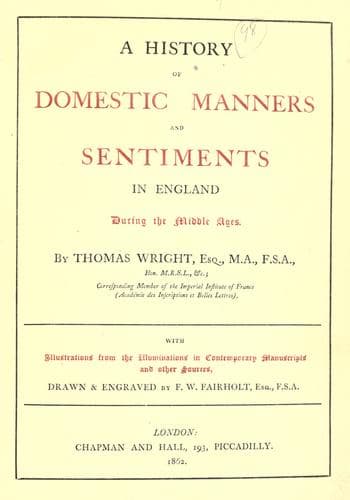
A History of Domestic Manners and Sentiments in England During the Middle AgesWright, Thomas
History
A History of Domestic Manners and Sentiments in England During the Middle Ages
Wright, Thomas
England -- Social life and customs -- 1066-1485
Among the aristocracy of the land, the education of the boy took what
was considered at that time a very practical turn--he was instructed
in behaviour, in manly exercises and the use of arms, in carving at
table--then looked upon as a most important accomplishment among
gentlemen--and in some other branches of learning which we should
hardly appreciate at present; but school learning was no mediæval
gentleman’s accomplishment, and was, in that light, quite an exception,
unless perhaps to a certain degree among the ladies. In the historical
romances of the middle ages, a prince or a baron is sometimes able
to read, but it is the result of accidental circumstances. Thus, in
the romance of the “Mort de Garin,” when the empress of the Franks
writes secret news from Paris to duke Garin, the head of the family of
the Loherains, it is remarked, as an unusual circumstance, that the
latter was able to read, and that he could thus communicate the secret
information of the empress to his friends without the assistance of
a scholar or secretary, which was a great advantage, as it prevented
one source of danger of the betrayal of the correspondence. “Garin the
Loherain,” says the narrator, “was acquainted with letters, for in his
infancy he was put to school until he had learned both Roman (French)
and Latin.”
_De letres sot li Loherens Garins;_
_Car en s’enfance fu à escole mis,_
_Tant que il sot et Roman et Latin._
--Mort de Garin, p. 105.
Education of this kind was bestowed more generally on the
_bourgeoisie_--on the middle and even the lower classes; and to these
school-education was much more generally accessible than we are
accustomed to imagine. From Anglo-Saxon times, indeed, every parish
church had been a public school. The Ecclesiastical Institutes (p. 475,
in the folio edition of the Laws, by Thorpe) directs that “Mass-priests
ought always to have at their houses a school of disciples; and if
any one desire to commit his little ones (_lytlingas_) to them for
instruction, they ought very gladly to receive them, and kindly teach
them.” It is added that “they ought not, however, for that instruction,
to desire anything from their relatives, except what they shall be
willing to do for them of their own accord.” In the Ecclesiastical
Canons, published under king Edgar, there is an enactment which would
lead us to suppose that the clergy performed their scholastic duties
with some zeal, and that priests were in the habit of seducing their
scholars from each other, for this enactment (p. 396) enjoins “that
no priest receive another’s scholar without leave of him whom he
previously followed.” This system of teaching was kept up during at
least several generations after the Norman conquest.
CHAPTER VII.
EARLY ENGLISH HOUSES.--THEIR GENERAL FORM AND DISTRIBUTION.
Public-domain text, read in full here on John Shaqi.
Reviews
Reviews
No reviews yet
Be the first to share your thoughts on this work.
Elsewhere in the archive
Join the Discussion
Join the discussion
Sign in to leave a comment or review.
Sign InorCreate an account