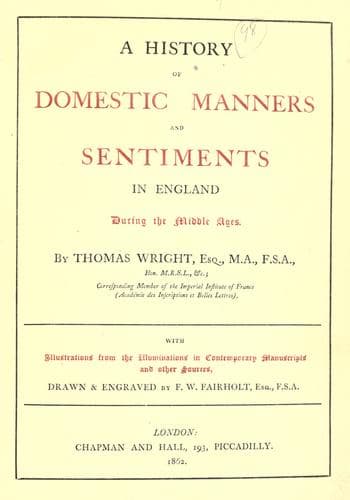
A History of Domestic Manners and Sentiments in England During the Middle AgesWright, Thomas
History
A History of Domestic Manners and Sentiments in England During the Middle Ages
Wright, Thomas
England -- Social life and customs -- 1066-1485
In the popular French and Anglo-Norman _fabliaux_, or tales in verse,
which belong mostly to the thirteenth century, we meet with many
incidents illustrating this distribution of the apartments of the
house, which no doubt continued essentially the same during that and
the following century. Thus in a fabliau published by M. Jubinal, an
old woman of mean condition in life, dame Auberée, is described as
visiting a burgher’s wife, who, with characteristic vanity, takes
her into the chamber adjoining (_en une chambre ilueques près_), to
show her her handsome bed. When the lady afterwards takes refuge with
dame Auberée, she also shows her out of the hall into a chamber close
adjoining (_en une chambre iluec de joste_). In a fabliau entitled
_Du prestre crucifié_, published by Méon, a man returning home at
night, sees what is going on in the hall through a _pertuis_, or hole
made through the wall for a window, before he opens the door (_par
un pertuis les a veuz_). In another fabliau published in the larger
collection of Barbazan, a lady in her chamber sees what is passing
in the hall _par un pertuis_. In the fabliau of _Le povre clerc_ (or
scholar), the clerc, having asked for a night’s lodging at the house of
a miller during the miller’s absence, is driven away by the wife, who
expects a visit from her lover the priest, and is unwilling to have an
intruder. The clerc, as he is going away, meets the miller, who, angry
at the inhospitable conduct of his dame, takes him back to the house.
The priest in the meantime had arrived, and is sitting in the hall
with the good wife, who, hearing a knock at the door, makes her lover
hide himself in the stable (_croiche_). From the stable the priest
watches the company in the hall through a window (_fenestre_), which
is evidently only another name for the _pertuis_. In one fabliau the
gallant comes through the court or garden, and is let into the hall by
the back door; in another a woman is introduced into the chamber by a
back door, or, as it is called in the text, a false door (_par un fax
huis_), while the hall is occupied by company.
The arrangements of an ordinary house in the country are illustrated
in the fabliau _De Barat et de Haimet_, printed in the collection of
Barbazan. Two thieves undertake to rob a third of “a bacon,” which he
(Travers) had hung on the beam or rafter of his house, or hall:--
_Travers l’avoit à une hart_
_Au tref de sa meson pendu._
Public-domain text, read in full here on John Shaqi.
Reviews
Reviews
No reviews yet
Be the first to share your thoughts on this work.
Elsewhere in the archive
Join the Discussion
Join the discussion
Sign in to leave a comment or review.
Sign InorCreate an account