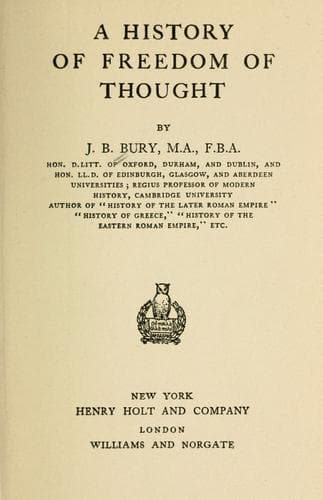
A History of Freedom of ThoughtBury, J. B. (John Bagnell)
Religion
A History of Freedom of Thought
Bury, J. B. (John Bagnell)
Free thought -- History; Rationalism -- History
[100] and civil wisdom.” For knowledge is advanced through the utterance
of new opinions, and truth is discovered by free discussion. If the
waters of truth “flow not in a perpetual progression they sicken into a
muddy pool of conformity and tradition.” Books which are authorized by
the licensers are apt to be, as Bacon said, “but the language of the
times,” and do not contribute to progress. The examples of the countries
where the censorship is severe do not suggest that it is useful for
morals: “look into Italy and Spain, whether those places be one scruple
the better, the honester, the wiser, the chaster, since all the
inquisitional rigour that hath been executed upon books.” Spain indeed
could reply, “We are, what is more important, more orthodox.” It is
interesting to notice that Milton places freedom of thought above civil
liberty: “Give me the liberty to know, to utter, and to argue freely
according to conscience, above all other liberties.”
With the restoration of the Monarchy and the Anglican Church, religious
liberty was extinguished by a series of laws against Dissenters. To the
Revolution we owe the Act of Toleration (1689) from which the religious
freedom which England enjoys at present is derived. It granted freedom
of worship to Presbyterians, Congregationalists,
[101] Baptists and Quakers, but only to these; Catholics and Unitarians
were expressly excepted and the repressive legislation of Charles II
remained in force against them. It was a characteristically English
measure, logically inconsistent and absurd, a mixture of tolerance and
intolerance, but suitable to the circumstances and the state of public
opinion at the time.
In the same year John Locke’s famous (first) Letter concerning
Toleration appeared in Latin. Three subsequent letters developed and
illustrated his thesis. The main argument is based on the principle that
the business of civil government is quite distinct from that of
religion, that the State is a society constituted only for preserving
and promoting the civil interests of its members —civil interests
meaning life, liberty, health, and the possession of property. The care
of souls is not committed to magistrates more than to other men. For the
magistrate can only use outward force; but true religion means the
inward persuasion of the mind, and the mind is so made that force cannot
compel it to believe. So too it is absurd for a State to make laws to
enforce a religion, for laws are useless without penalties, and
penalties are impertinent because they cannot convince.
Moreover, even if penalties could change
Public-domain text, read in full here on John Shaqi.
Reviews
Reviews
No reviews yet
Be the first to share your thoughts on this work.
Elsewhere in the archive
Join the Discussion
Join the discussion
Sign in to leave a comment or review.
Sign InorCreate an account