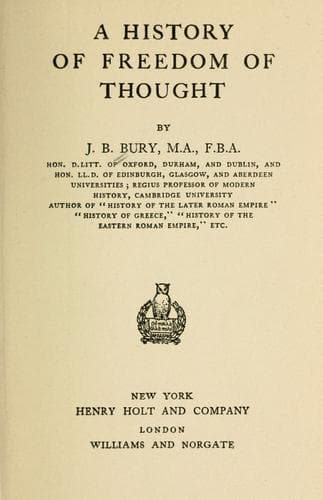
A History of Freedom of ThoughtBury, J. B. (John Bagnell)
Religion
A History of Freedom of Thought
Bury, J. B. (John Bagnell)
Free thought -- History; Rationalism -- History
[2] Complete toleration was established by Penn in the Quaker Colony of
Pennsylvania in 1682.
[3] Especially Chillingworth’s Religion of Protestants (1637), and
Jeremy Taylor’s Liberty of Prophesying (1646).
[4] The Reformed Church consists of the followers of Calvin and Zwingli.
CHAPTER VI
THE GROWTH OF RATIONALISM
(SEVENTEENTH AND EIGHTEENTH CENTURIES)
DURING the last three hundred years reason has been slowly but steadily
destroying Christian mythology and exposing the pretensions of
supernatural revelation. The progress of rationalism falls naturally
into two periods. (1) In the seventeenth and eighteenth centuries those
thinkers who rejected Christian theology and the book on which it relies
were mainly influenced by the inconsistencies, contradictions, and
absurdities which they discovered in the evidence, and by the moral
[128] difficulties of the creed. Some scientific facts were known which
seemed to reflect on the accuracy of Revelation, but arguments based on
science were subsidiary. (2) In the nineteenth century the discoveries
of science in many fields bore with full force upon fabrics which had
been constructed in a naïve and ignorant age; and historical criticism
undermined methodically the authority of the sacred documents which had
hitherto been exposed chiefly to the acute but unmethodical criticisms
of common sense.
A disinterested love of facts, without any regard to the bearing which
those facts may have on one’s hopes or fears or destiny, is a rare
quality in all ages, and it had been very rare indeed since the ancient
days of Greece and Rome. It means the scientific spirit. Now in the
seventeenth century we may say (without disrespect to a few precursors)
that the modern study of natural science began, and in the same period
we have a series of famous thinkers who were guided by a disinterested
love of truth. Of the most acute minds some reached the conclusion that
the Christian scheme of the world is irrational, and according to their
temperament some rejected it, whilst others, like the great Frenchman
Pascal, fell back upon an unreasoning act of faith. Bacon, who professed
[129] orthodoxy, was perhaps at heart a deist, but in any case the whole
spirit of his writings was to exclude authority from the domain of
scientific investigation which he did so much to stimulate. Descartes,
illustrious not only as the founder of modern metaphysics but also by
his original contributions to science, might seek to conciliate the
ecclesiastical authorities—his temper was timid— but his philosophical
method was a powerful incentive to rationalistic thought. The general
tendency of superior intellects was to exalt reason at the expense of
authority; and in England this principle was established so firmly by
Locke, that throughout the theological warfare of the eighteenth century
both parties relied on reason, and no theologian of repute assumed faith
to be a higher faculty.
Public-domain text, read in full here on John Shaqi.
Reviews
Reviews
No reviews yet
Be the first to share your thoughts on this work.
Elsewhere in the archive
Join the Discussion
Join the discussion
Sign in to leave a comment or review.
Sign InorCreate an account