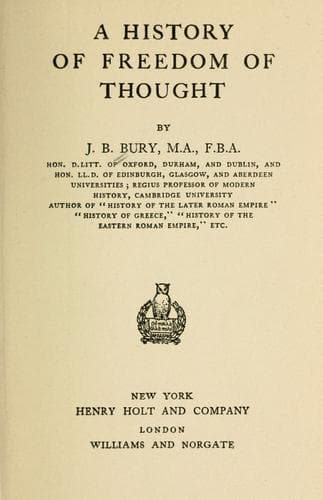
A History of Freedom of ThoughtBury, J. B. (John Bagnell)
Religion
A History of Freedom of Thought
Bury, J. B. (John Bagnell)
Free thought -- History; Rationalism -- History
[143] quarrel for it, or as others cast a piece of money among a company
of boys for the sport of seeing them scramble for it, so was the pastime
of the angels here.” In dealing with the healing of the woman who
suffered from a bloody flux, he asks: “What if we had been told of the
Pope’s curing an haemorrhage like this before us, what would Protestants
have said to it? Why, ‘that a foolish, credulous, and superstitious
woman had fancied herself cured of some slight indisposition, and the
crafty Pope and his adherents, aspiring after popular applause,
magnified the presumed cure into a miracle.’ The application of such a
supposed story of a miracle wrought by the Pope is easy; and if
Infidels, Jews, and Mahometans, who have no better opinion of Jesus than
we have of the Pope, should make it, there’s no help for it.”
Woolston professed no doubts of the inspiration of Scripture. While he
argued that it was out of the question to suppose the miracles literally
true, he pretended to believe in the fantastic theory that they were
intended allegorically as figures of Christ’s mysterious operations in
the soul of man. Origen, a not very orthodox Christian Father, had
employed the allegorical method, and Woolston quotes him in his favour.
His
[144] vigorous criticisms vary in value, but many of them hit the nail
on the head, and the fashion of some modern critics to pass over
Woolston’s productions as unimportant because they are “ribald” or
coarse, is perfectly unjust. The pamphlets had an enormous sale, and
Woolston’s notoriety is illustrated by the anecdote of the “jolly young
woman” who met him walking abroad and accosted him with “You old rogue,
are you not hanged yet?” Mr. Woolston answered, “Good woman, I know you
not; pray what have I done to offend you?” “You have writ against my
Saviour,” she said; “what would become of my poor sinful soul if it was
not for my dear Saviour?”
About the same time, Matthew Tindal (a Fellow of All Souls) attacked
Revelation from a more general point of view. In his Christianity as old
as the Creation (1730) he undertook to show that the Bible as a
revelation is superfluous, for it adds nothing to natural religion,
which God revealed to man from the very first by the sole light of
reason. He argues that those who defend Revealed religion by its
agreement with Natural religion, and thus set up a double government of
reason and authority, fall between the two. “It ’s an odd jumble,” he
observes, “to prove the truth of a book by the truth
Public-domain text, read in full here on John Shaqi.
Reviews
Reviews
No reviews yet
Be the first to share your thoughts on this work.
Elsewhere in the archive
Join the Discussion
Join the discussion
Sign in to leave a comment or review.
Sign InorCreate an account