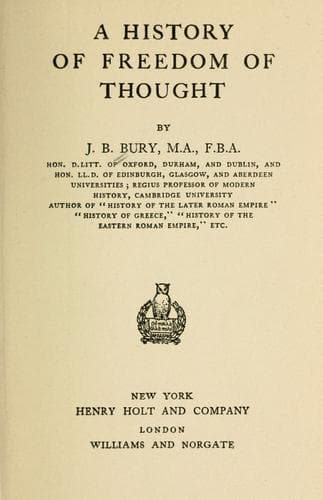
A History of Freedom of ThoughtBury, J. B. (John Bagnell)
Religion
A History of Freedom of Thought
Bury, J. B. (John Bagnell)
Free thought -- History; Rationalism -- History
[161] sense, education, and learning, as to secure us against all
delusion in themselves; of such undoubted integrity as to place them
beyond all suspicion of any design to deceive others; of such credit in
the eyes of mankind as to have a great deal to lose in case of their
being detected in any falsehood, and at the same time attesting facts
performed in such a public manner as to render detection unavoidable
—all which circumstances are requisite to give us a full assurance in
the testimony of men.
In the Dialogues on Natural Religion which were not published till after
his death (1776), Hume made an attack on the “argument from design,” on
which deists and Christians alike relied to prove the existence of a
Deity. The argument is that the world presents clear marks of design,
endless adaptation of means to ends, which can only be explained as due
to the deliberate plan of a powerful intelligence. Hume disputes the
inference on the ground that a mere intelligent being is not a
sufficient cause to explain the effect. For the argument must be that
the system of the material world demands as a cause a corresponding
system of interconnected ideas; but such a mental system would demand an
explanation of its existence just as much as the material world; and
thus we find ourselves
[162] committed to an endless series of causes. But in any case, even if
the argument held, it would prove only the existence of a Deity whose
powers, though superior to man’s, might be very limited and whose
workmanship might be very imperfect. For this world may be very faulty,
compared to a superior standard. It may be the first rude experiment “of
some infant Deity who afterwards abandoned it, ashamed of his lame
performance”; or the work of some inferior Deity at which his superior
would scoff; or the production of some old superannuated Deity which
since his death has pursued an adventurous career from the first impulse
which he gave it. An argument which leaves such deities in the running
is worse than useless for the purposes of Deism or of Christianity.
The sceptical philosophy of Hume had less influence on the general
public than Gibbon’s Decline and Fall of the Roman Empire. Of the
numerous freethinking books that appeared in England in the eighteenth
century, this is the only one which is still a widely read classic. In
what a lady friend of Dr. Johnson called “the two offensive chapters”
(XV and XVI) the causes of the rise and success of Christianity are for
the first time critically investigated as a simple historical
phenomenon. Like most freethinkers of the
Public-domain text, read in full here on John Shaqi.
Reviews
Reviews
No reviews yet
Be the first to share your thoughts on this work.
Elsewhere in the archive
Join the Discussion
Join the discussion
Sign in to leave a comment or review.
Sign InorCreate an account