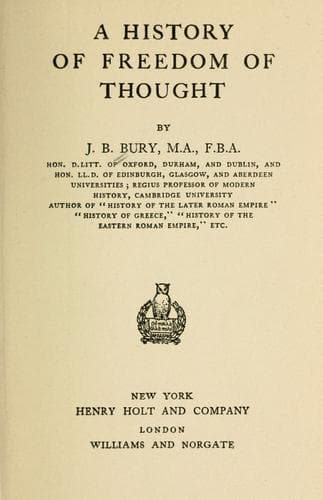
A History of Freedom of ThoughtBury, J. B. (John Bagnell)
Religion
A History of Freedom of Thought
Bury, J. B. (John Bagnell)
Free thought -- History; Rationalism -- History
The phenomena of nature are a system of things which co-exist and follow
each other according to invariable laws. This deadly proposition was
asserted early in the nineteenth century to be an axiom of science. It
was formulated by Mill (in his System of Logic, 1843) as the foundation
on which scientific induction rests. It means that at any moment the
state of the whole universe is the effect of its state at the preceding
moment; the casual sequence between two successive states is not broken
by any arbitrary interference suppressing or altering the relation
between cause and effect. Some ancient Greek philosophers were convinced
of this principle; the work done by modern science in every field seems
to be a verification of it. But it need not be stated in such an
absolute form. Recently, scientific men have been inclined to express
the axiom with more reserve and less dogmatically. They are prepared to
recognize that it is simply a postulate without which the scientific
comprehension of the universe would be impossible, and they are inclined
to state it not as a law of causation—for the idea of causation leads
into metaphysics—but rather as uniformity of experience. But they are
not
[184] readier to admit exceptions to this uniformity than their
predecessors were to admit exceptions to the law of causation.
The idea of development has been applied not only to nature, but to the
mind of man and to the history of civilization, including thought and
religion. The first who attempted to apply this idea methodically to the
whole universe was not a student of natural science, but a
metaphysician, Hegel. His extremely difficult philosophy had such a wide
influence on thought that a few words must be said about its tendency.
He conceived the whole of existence as what he called the Absolute Idea,
which is not in space or time and is compelled by the laws of its being
to manifest itself in the process of the world, first externalizing
itself in nature, and then becoming conscious of itself as spirit in
individual minds. His system is hence called Absolute Idealism. The
attraction which it exercised has probably been in great measure due to
the fact that it was in harmony with nineteenth-century thought, in so
far as it conceived the process of the world, both in nature and spirit,
as a necessary development from lower to higher stages. In this respect
indeed Hegel’s vision was limited. He treats the process as if it were
practically complete already, and does not take into account
Public-domain text, read in full here on John Shaqi.
Reviews
Reviews
No reviews yet
Be the first to share your thoughts on this work.
Elsewhere in the archive
Join the Discussion
Join the discussion
Sign in to leave a comment or review.
Sign InorCreate an account