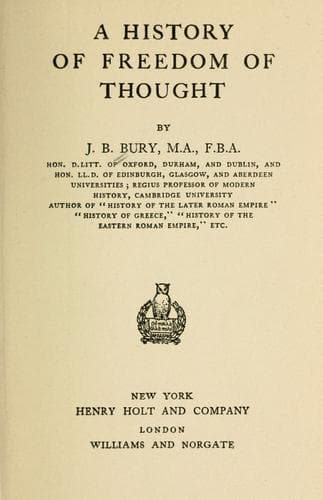
A History of Freedom of ThoughtBury, J. B. (John Bagnell)
Religion
A History of Freedom of Thought
Bury, J. B. (John Bagnell)
Free thought -- History; Rationalism -- History
For such minds science has only succeeded in carrying some
entrenchments, which may be abandoned without much harm. It has made the
old orthodox view of the infallibility of the Bible untenable, and upset
the doctrine of the Creation and Fall. But it would still be possible
for Christianity to maintain the supernatural claim, by modifying its
theory of the authority of the Bible and revising its theory of
redemption, if the evidence of natural science were the only group of
facts with which it collided. It might be argued that the law of
universal causation is a hypothesis inferred from experience, but that
experience includes the testimonies of history and must therefore take
account of the clear evidence of miraculous occurrences in the New
Testament (evidence which is valid, even if that book was not inspired).
Thus, a stand could be taken against the generalization of science on
the firm ground of historical fact. That solid ground, however, has
given
[192] way, undermined by historical criticism, which has been more
deadly than the common-sense criticism of the eighteenth century.
The methodical examination of the records contained in the Bible,
dealing with them as if they were purely human documents, is the work of
the nineteenth century. Something, indeed, had already been done.
Spinoza, for instance (above, p. 138), and Simon, a Frenchman whose
books were burnt, were pioneers; and the modern criticism of the Old
Testament was begun by Astruc (professor of medicine at Paris), who
discovered an important clue for distinguishing different documents used
by the compiler of the Book of Genesis (1753). His German contemporary,
Reimarus, a student of the New Testament, anticipated the modern
conclusion that Jesus had no intention of founding a new religion, and
saw that the Gospel of St. John presents a different figure from the
Jesus of the other evangelists.
But in the nineteenth century the methods of criticism, applied by
German scholars to Homer and to the records of early Roman history, were
extended to the investigation of the Bible. The work has been done
principally in Germany. The old tradition that the Pentateuch was
written by Moses has been completely discredited. It is now
Public-domain text, read in full here on John Shaqi.
Reviews
Reviews
No reviews yet
Be the first to share your thoughts on this work.
Elsewhere in the archive
Join the Discussion
Join the discussion
Sign in to leave a comment or review.
Sign InorCreate an account