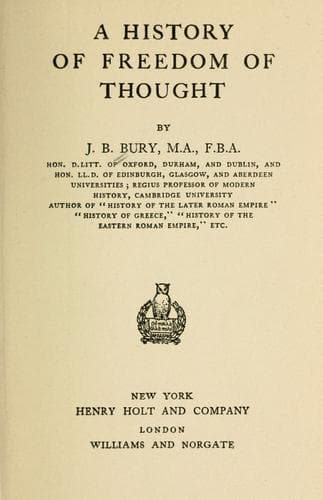
A History of Freedom of ThoughtBury, J. B. (John Bagnell)
Religion
A History of Freedom of Thought
Bury, J. B. (John Bagnell)
Free thought -- History; Rationalism -- History
[195] only in their tendencies (since they reflect the spirit of
different ages), but also in some respects in substance. The examination
of most of the other Old Testament books has led to conclusions likewise
adverse to the orthodox view of their origin and character. New
knowledge on many points has been derived from the Babylonian literature
which has been recovered during the last half century. One of the
earliest (1872) and most sensational discoveries was that the Jews got
their story of the Flood from Babylonian mythology.
Modern criticism of the New Testament began with the stimulating works
of Baur and of Strauss, whose Life of Jesus (1835), in which the
supernatural was entirely rejected, had an immense success and caused
furious controversy. Both these rationalists were influenced by Hegel.
At the same time a classical scholar, Lachmann, laid the foundations of
the criticism of the Greek text of the New Testament, by issuing the
first scientific edition. Since then seventy years of work have led to
some certain results which are generally accepted.
In the first place, no intelligent person who has studied modern
criticism holds the old view that each of the four biographies of Jesus
is an independent work and an independent
[196] testimony to the facts which are related. It is acknowledged that
those portions which are common to more than one and are written in
identical language have the same origin and represent only one
testimony. In the second place, it is allowed that the first Gospel is
not the oldest and that the apostle Matthew was not its author. There is
also a pretty general agreement that Mark’s book is the oldest. The
authorship of the fourth Gospel, which like the first was supposed to
have been written by an eye-witness, is still contested, but even those
who adhere to the tradition admit that it represents a theory about
Jesus which is widely different from the view of the three other
biographers.
The result is that it can no longer be said that for the life of Jesus
there is the evidence of eye-witnesses. The oldest account (Mark) was
composed at the earliest some thirty years after the Crucifixion. If
such evidence is considered good enough to establish the supernatural
events described in that document, there are few alleged supernatural
occurrences which we shall not be equally entitled to believe. As a
matter of fact, an interval of thirty years makes little difference, for
we know that legends require little time to grow. In the East, you will
hear of miracles which happened the day before
[197] yesterday. The birth of religions is always enveloped in legend,
and the miraculous thing would be, as M. Salomon Reinach has observed,
if the story of the birth of Christianity were pure history.
Public-domain text, read in full here on John Shaqi.
Reviews
Reviews
No reviews yet
Be the first to share your thoughts on this work.
Elsewhere in the archive
Join the Discussion
Join the discussion
Sign in to leave a comment or review.
Sign InorCreate an account