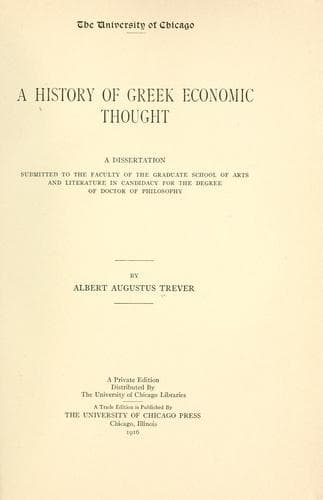
A History of Greek Economic ThoughtTrever, Albert Augustus
History
A History of Greek Economic Thought
Trever, Albert Augustus
Economics -- Greece -- History; Thesis (Ph. D.)
We have seen that Plato, in the _Laws_, while apparently granting
private property in land, really denies this, since he makes the product
of the land practically public property.[839] Aristotle, despite his
strictures against communism, advocates a system of land tenure quite
similar. His limitation of the freedom of donation or testament,
purchase or sale; his demands that the lot shall never leave the family,
that it shall always be handed down by legitimate succession, and that
no citizen shall ever be allowed to hold more than one allotment, are
all Platonic, and make him unquestionably an advocate of family, rather
than of private ownership of land.[840] His collectivism is more direct
than that of the _Laws_, since he makes part of the land entirely
public, to defray the expense of worship and the common meals.[841] The
assignment of lots to the citizens is on the same terms as in the
_Laws_, with the exception that the owners are masters of the product of
their lots.[842] Despite his criticism of Plato’s division of
homesteads, he has the same plan.[843] As in the _Laws_, only citizens
are landowners, and this includes only the governing and military
classes,[844] while all husbandmen are to be public or private
slaves.[845] Unlike Plato, however, Aristotle does not attempt to avoid
undue inequalities in personal property.[846] He sets no maximum above
which limit goods must be confiscated, nor does he, as Plato, establish
a rigorous system of laws to hamper trade and to make money-making
operations practically impossible. He recognizes that such regulations
are not feasible, and his legislation is therefore more considerate of
human nature, despite the fact that his hostility to the ideal of
commercialism is even more pronounced than is that of Plato.[847]
Public-domain text, read in full here on John Shaqi.
Reviews
Reviews
No reviews yet
Be the first to share your thoughts on this work.
Elsewhere in the archive
Join the Discussion
Join the discussion
Sign in to leave a comment or review.
Sign InorCreate an account