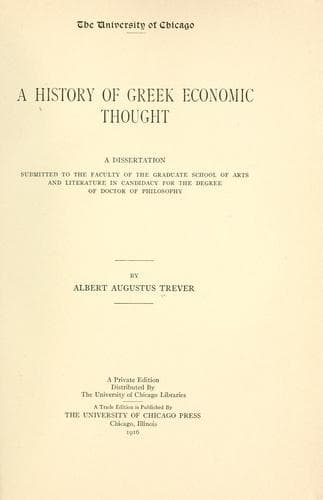
A History of Greek Economic ThoughtTrever, Albert Augustus
History
A History of Greek Economic Thought
Trever, Albert Augustus
Economics -- Greece -- History; Thesis (Ph. D.)
Besides St. Hilaire and Zmavc, cited above, among those favorable are
Cossa, _Hist. des doctrines economiques_, p. 149; Blanqui, _op. cit._,
I, 49, 86. More reserved are Souchon, _op. cit._, p. 127; DuBois, _op.
cit._, p. 50; Haney, _op. cit._, pp. 47 f.; unfair interpretation,
Dühring, _op. cit._, pp. 20 f.
Footnote 522:
i. 9. 1257_a_6-9: ἑκάστου γὰρ κτήματος διττὴ ἡ χρῆσίς ἐστιν ἀμφότεραι
δὲ καθ᾽ αὑτὸ μὲν ἀλλ᾽ οὐχ ὁμοίως καθ᾽ αὑτό, ἀλλ᾽ ἡ μὲν οἰκεία ἡ δ᾽ οὐκ
οἰκεία τοῦ πράγματος οἱον ὑποδήματος ἥ τε ὑπόδεσις καὶ ἡ μεταβλητική.
Footnote 523:
_Wealth of Nations_, I, chap. iv.
Footnote 524:
Cf. Souchon, _op. cit._, p. 127; Haney, _op. cit._, p. 47.
Footnote 525:
Unless this is implied in κτήματος, 1257_a_6, as ἔστι γὰρ ἡ
μεταβλητικὴ πάντων (14 f.) might seem to indicate. Zmavc (_Archiv._,
etc., p. 410) points to 1253_b_33-39, on the automatic tripods of
Hephaestus, as implying it, but if so it was unintended by Aristotle.
But cf. _infra_, pp. 84 and 86, n. 4, where it is recognized.
Footnote 526:
1257_a_11; 5-19, but not specifically stated, and the term χρεία does
not occur here.
Footnote 527:
i. 7. 14: καὶ τὸ σπανιώτερον τοῦ ἀφθόνου, οἷον χρυσὸς σιδήρου
ἀχρηστότερος ὤν· ἄλλον δὲ τρόπον τε ἄφθονον τοῦ σπανίου, ὅτι ἡ χρῆσις
ὑπερέχει· τὸ γὰρ πολλάκις τοῦ ὀλιγάκις ὑπερέχει· ὅθεν λέγεται ἄριστον
μὲν ὕδωρ. Cf. Pind. _Ol._ i. 1 and Cope-Sandys ed. of Ar. _Rhet._ (I,
pp. 130 f., 1877).
Footnote 528:
_Ibid._
Footnote 529:
V, v. 8-14. 1133_a_5-1133_b_10 ff.
Footnote 530:
E.g., Stewart.
Footnote 531:
1133_a_5-12; 15 f.; 18; cf. _Eud. Eth._ vii. 10. 1243_b_28-38.
Footnote 532:
_N. Eth._ 1133_a_5-12, etc., 12 f.: οὐθὲν γὰρ κωλύει κρεῖττον εἶναι το
θατέρου ἔργον ἢ τὸ θατέρου. The emphasis seems to be on quality of
labor, as suggested by κρεῖττον. Cf. both ὅσον and οἷον (15) and p. 84
n. 3.
Footnote 533:
_Ibid._ 7-10; by joining means and extremes together, the
proportionate exchange is effected. Cf. also 1133_b_4 ff.; 1133_a_32
f. As observed by Ritchie (Palgrave’s _Dictionary_, art. “Aristotle”)
and H. Sewall (_op. cit._, p. 3, n. 2), the proportion is clearer to
moderns if we make our standard one hour of labor of each workman
instead of the men themselves.
Footnote 534:
Stewart (_Notes to N. Eth._ I, 449) suggests that this gives what the
economists call “natural value,” but that the market value oscillates
from this because of supply and demand.
Footnote 535:
1133_a_25-27; 1133_b_6 f. Cf. p. 34, n. 5, for Plato’s use of the
term.
Footnote 536:
_Op. cit._, pp. 47 f.
Footnote 537:
Cf. the discussion and notes above; also 1133_a_15 f., where both
elements seem to be recognized, though the meaning of the passage is
disputed. Cf. _infra_, p. 108, n. 3.
Footnote 538:
Public-domain text, read in full here on John Shaqi.
Reviews
Reviews
No reviews yet
Be the first to share your thoughts on this work.
Elsewhere in the archive
Join the Discussion
Join the discussion
Sign in to leave a comment or review.
Sign InorCreate an account