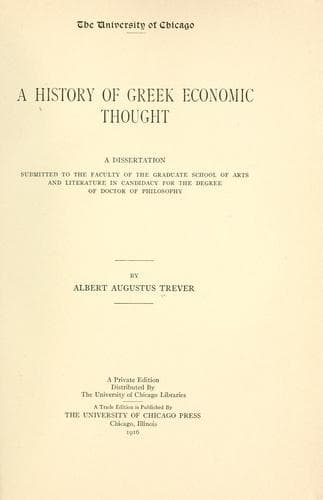
A History of Greek Economic ThoughtTrever, Albert Augustus
History
A History of Greek Economic Thought
Trever, Albert Augustus
Economics -- Greece -- History; Thesis (Ph. D.)
_Pol._ i. 8. 1256_b_31 f.; _N. Eth._ i. 8. 1099_a_31-33, especially
ἁδύνατον γὰρ ἢ οὐ ῥάδιον τὰ καλὰ πράττειν ἀχορήγητον ὄντα; 1101_a_14
f., in the definition of the εὐδαίμων man.
Footnote 557:
_Pol._ iii. 6. 1265_a_32 f.: ἐλευθέρως; _N. Eth._ iii., chaps. 13-14
on σωφροσύνη, and iv, chaps. 1, 2, on ἐλευθεριότης and ἀσωτία; but
display of wealth is vulgar (iv. 2. 1123_a_19-22). Ruskin (_Stones of
Venice_, VIII, 69 [Vol. X, 389]) refers to Aristotle on liberality.
Footnote 558:
ἡ δὲ πενία στάσιν ἐμποιεῖ καί κακουργίαν.
Footnote 559:
v. 1. 1129_b_3; so _Mag. mor._ B. 3. 1199_b_6-9, 14-35; cf. _N. Eth._
i. 8. 1098_b_31 ff. for a similar distinction between habit (ἕξις) and
practice (χρῆσις) of virtue.
Footnote 560:
v. 1. 1129_b_4-6; cf. _Pol._ i. 10. 1258_a_23-27 on the duty of the
weaver or statesman; iv (vii). 15. 1334_a_36 f.; 13. 1332_a_22 f.
Footnote 561:
_Pol._ 1332_a_25 f.
Footnote 562:
_Pol._ iv (vii). 13. 1332_a_26 f.
Footnote 563:
_N. Eth._ i. 8. 1098_b_12-15; cf. _Pol._ 1323_a_25 f.; _Rhet._ i. 5.
1360_b_25 ff.; also _Mag. mor._ A. 3. 1184_b_1-5 and _Eud. Eth._ ii.
1. 1218_b_32.
Footnote 564:
_Pol._ 1323_a_40 f.; cf. Jesus’ sentence, “Seek ye first,” etc.; cf.
also 1323_b_19 f.; also pp. 24 ff., Plato.
Footnote 565:
_Pol._ 1323_b_, 1-6.
Footnote 566:
_N. Eth._ i. 5. 1096_a_5 f.: ὁ δὲ χρηματιστὴς βίαιος τίς ἐστιν. Cf.
also _Pol._ 1256_b_28-32, discussed above, and i., chaps. 8 and 9,
discussed under exchange.
Footnote 567:
Cf. n. 2.
Footnote 568:
_Pol._ 1323_b_7-11, and discussion above.
Footnote 569:
1256_b_36; _N. Eth._ i. 5. 1906_a_6 f.; χρήσιμον γὰρ καὶ ἄλλου χάριν;
7. 1097_a_27: δῆλον ὡς οὔκ ἐστι πάντα τέλεια.
Footnote 570:
_Pol._ i. 9. 1258_a_2 ff.; cf. also _Mag. mor._ B. 3. 1200_a-b_.
Footnote 571:
1258_a_10-14, similar to Plato _Rep._ i. on the arts and their
function; cf. a similar passage from _Isocrates_ (_Paneg._ 76) on the
virtues of the Persian War heroes.
Footnote 572:
_Pol._ iii. 9. 1280_a_25-32; the chief ambition of a state is not τῶν
κτημάτων χάριν, but εῦ ζῆν. Cf. above on the similar preachments of
Plato, for their relation to modern economic ideas and conditions. Cf.
Plato _Crito_ 48B: οὐ τὸ ζῆν περὶ πλείστου ποιητέον, ἀλλὰ τὸ εῦ ζῆν.
Footnote 573:
Cf. Souchon, _op. cit._, p. 69; for Greek terms for production, cf. p.
66 and notes.
Footnote 574:
i. 10. 1258_a_19-38; 4. 1254_a_7: ὁ δὲ βίος πρᾶξις, οὐ ποίησις ἐστιν.
Footnote 575:
10. 1258_a_33 ff., τῆς ὑπερετικῆς, impossible for the economist, but
true, for the moralist; cf. p. 69 for his distinction (1254_a_1 ff.)
between ὄργανα ποιητικά and κτῆμα πρακτικόν.
Footnote 576:
i. 2.; on both the above, cf. Newman, _op. cit., in loc._
Footnote 577:
Cf. especially 1258_a_34 ff.: μάλιστα δὲ, καθάπερ εἴρεται πρότερον,
δεῖ φύσει τοῦτο ὑπάρχειν. Cf. Susemihi and Hicks, _Pol. of Ar._, I
(1894), Intro., p. 30.
Footnote 578:
Public-domain text, read in full here on John Shaqi.
Reviews
Reviews
No reviews yet
Be the first to share your thoughts on this work.
Elsewhere in the archive
Join the Discussion
Join the discussion
Sign in to leave a comment or review.
Sign InorCreate an account