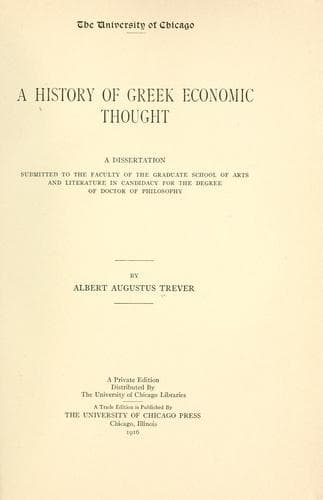
A History of Greek Economic ThoughtTrever, Albert Augustus
History
A History of Greek Economic Thought
Trever, Albert Augustus
Economics -- Greece -- History; Thesis (Ph. D.)
On this double tendency in the Stoics, and reasons therefore, cf.
Souchon (_op. cit._, pp. 173 f.); Poehlmann (_op. cit._, II, 342 f.,
and I, 111) and Wolf (_op. cit._, pp. 116 ff.) exaggerate their
socialistic tendency. For further discussion, cf. _infra_. Cf. L.
Stein, _Soc. Frage_, pp. 171-80.
Footnote 1017:
280-206 B.C. Aristo and Cleanthes, successors of Zeno, also emphasized
similar doctrines in relation to wealth. Cf. von Arnim, I, p. 89, frs.
396, 397, 398, from Aristo; _ibid._, p. 137, fr. 617, from Cleanthes.
Footnote 1018:
_Ibid._, II, 79, fr. 240; III, 28, fr. 117; p. 29, frs. 122, 123; p.
32, fr. 135.
Footnote 1019:
_Ibid._, III, 156, fr. 598; p. 159, fr. 618; p. 155, fr. 593.
Footnote 1020:
_Ibid._, p. 155, fr. 597.
Footnote 1021:
_Ibid._, p. 160, fr. 629, “Lucro autem numquam sapiens studet.”
Footnote 1022:
_Ibid._, p. 169, fr. 623: μόνον δὲ τὸν σπουδαῖον ἄνορα χρηματιστικὸν
εἶναι, γινώσκοντα ἀφ᾽ ὧν, χρηματιστέον, καὶ πότε καὶ πῶς καὶ μέχρι
πότε.
Footnote 1023:
Von Arnim, III, 168, fr. 674.
Footnote 1024:
_Ibid._, p. 36, frs. 151, 152, “Bonum ex malo non fit: divitiae fiunt:
fiunt autem ex avaritia divitiae ergo non sunt bonum” (Seneca _Ep._
87. 22).
Footnote 1025:
Von Arnim, p. 172, fr. 686 (Stob. _Ecl._ ii. 7, p. 109, 10): ....
λόγους κατηλεύειν, οὐ φαμένων δεῖν ἀπὸ παιδείας παρὰ τῶν ἐπιτυχόντων
χρηματίζεσθαι.
Footnote 1026:
Von Arnim, p. 86, fr. 352: ἄνθρωπος γὰρ ἐκ φύσεως δοῦλος οὐδείς; p.
87, fr. 358; cf. p. 141, n. 7, above.
Footnote 1027:
_Ibid._, fr. 357.
Footnote 1028:
_Ibid._, 89, fr. 365; p. 86, frs. 356, 354.
Footnote 1029:
_Ibid._, p. 86, fr. 355; p. 88, fr. 362; p. 89, 364. Cf. Espinas,
_Hist. des doctrines èconomiques_, 56 f., on the Stoics’ attitude
toward labor and slavery: “Ni les Cyniques ni les Stoiciens ne
méprisaient le travail”; “La seule servitude déshonorante est celle
des passions et du vice.”
Footnote 1030:
Poehlmann (_op. cit._, II, 342 f. and notes), citing von Arnim, III,
77, fr. 314, ὁ νόμος πάντων ἐστὶ βασιλεύς, etc., thinks Chrysippus’
principle of the law of reason as king of all is anti-individualistic.
He cites also Cic. _De fin._ iii. 19 (64), where the individual seems
to be made to exist for the sake of the whole. But cf. above, p. 140
f. and notes.
Footnote 1031:
Cf. Diog. L. vii. 131, and above, p. 140, nn. 7 f.
Footnote 1032:
_Op. cit._, p. 171.
Footnote 1033:
Cf. above, on Cynics and Stoics, and _infra_; cf. even in Plato,
_Laws_ 679A-B.
Footnote 1034:
The Socratics were the pioneers in this regard also. On the
unhistorical character of the alleged early communism in Sparta, cf.
Poehlmann, _op. cit._, I, 75 ff. and 100 f.; on this triple tendency
in the post-Aristotelian social thought, cf. _ibid._, pp. 99 ff., on
“Der Sozialstaat der Legende und das sozialistische Naturrecht”; also
Souchon, p. 172.
Footnote 1035:
Cf. above, p. 140.
Footnote 1036:
Public-domain text, read in full here on John Shaqi.
Reviews
Reviews
No reviews yet
Be the first to share your thoughts on this work.
Elsewhere in the archive
Join the Discussion
Join the discussion
Sign in to leave a comment or review.
Sign InorCreate an account