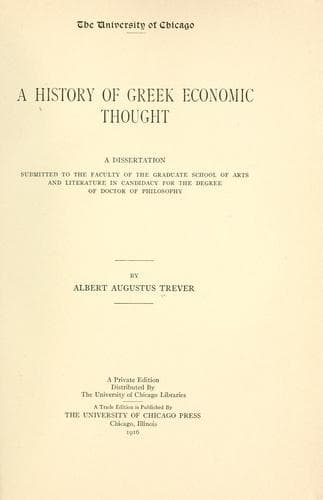
A History of Greek Economic ThoughtTrever, Albert Augustus
History
A History of Greek Economic Thought
Trever, Albert Augustus
Economics -- Greece -- History; Thesis (Ph. D.)
Cf. _Laws_ 889 D-E, 709 B-D, and Robin, _op. cit._, pp. 224 f.; also
the entire argument of the _Republic_ on justice.
Footnote 73:
_Laws_ 921B. The word is ἀξία.
Footnote 74:
_Ibid._: γιγνώσκει γὰρ ὅγε δημιουργὸς τὴν ἀξίαν.
Footnote 75:
Cf. p. 15, n. 7 above.
Footnote 76:
_Euthydemus_ 280B-E, 281B, D, 288E-289A; _Meno_ 88D-E.
Footnote 77:
_Unto This Last_, IV, 62: “Useful articles that we can use”; 64:
“Wealth is the possession of the valuable by the valiant” (Vol. XVII,
86 ff.); _Fors Clavigera_, Letter 70 (Vol. XXVIII, 712 ff.); _Munera
Pulveris_, I, 14 (Vol. XVII, 154); II, 35 (Vol. XVII, 166 f.). Plato’s
economic ideas greatly influenced Ruskin. Cf. _infra_, p. 149, n. 2.
Cf. also Vol. XXXVIII, 112; XXXIX, 411, of Ruskin. He says, in the
preface to _Unto This Last_ (Vols. XVII, XVIII), that his “real
purpose is to give ... a logical definition of wealth,” which has
“often been given incidentally in good Greek by Plato and Xenophon.”
Cf. _ibid._, n. 1, for other such references.
Footnote 78:
_Ibid._
Footnote 79:
Cf. above note and _Mun. Pul._, II, 30, notes; _Fors Clav._, Letter
70, 3 (Vol. XXVII, 713), the “good things.”
Footnote 80:
_Fors Clav._, Lett. 70, 8 f. (Vol. XXVIII, 718 ff.), where he refers
to Plato’s _Laws_ 727A.
Footnote 81:
Cf. _infra_ for citations.
Footnote 82:
Cf. p. 23 and notes.
Footnote 83:
_Laws_ 697B, 631C, 728A, 870B; _Apol._ 29D-E.
Footnote 84:
_Apol._ 30B; also _Laws_ 743E; _Gorg._ 451E; cf. Ruskin, _Fors Clav._,
Lett. 70, 6 and 11 (Vol. XXVIII, 717), where he cites _Laws_ 726-728A,
on the value of the soul. He also cites _Laws_ 742-743 and _Rep._ 416E
(cf. _Mun. Pul._ [Vol. XVII, 89, 148]).
Footnote 85:
_Laws_ 743E.
Footnote 86:
831C-D. Ruskin (_Crown of Wild Olive_, 83, Vol. XVIII, 456 f.) cites
_Critias_ 120E ff., in urging the same idea. He also cites Plato’s
myth of the metals, _Rep._ 416E, in similar vein (_Mun. Pul._, III,
89, Vol. XVII, 211).
Footnote 87:
631C cited by Ruskin, _Mun. Pul._, III, 88 (Vol. XVII, 210).
Footnote 88:
661A, 661B; _Rep._ 331A-B.
Footnote 89:
_Laws_ 661B; _Hipp. Maj._ 290D; _Menex._ 246E.
Footnote 90:
_Mun. Pul._, II, 35 ff.; he refers to both Xenophon and Plato as being
right on this point. Cf. _Fors. Clav._, I, 8 (Vol. XXVII, 122); _Unto
This Last_, 64 (Vol. XVII, 89).
Footnote 91:
_Rep._ 550D, 373D: ἐὰν καὶ ἐκεῖνοι ἀφῶσιν αὑτοὺς ἐπὶ χρημάτων κτῆσιν
ἄπειρον ὑπερβάντες τὸν τῶν ἀναγκαίων ὄρον. On ἄπειρος cf. _infra_
under Aristotle. Cf. Dobbs, _op. cit._, pp. 202 f. and note, on the
evil results of excessive wealth and poverty in the Greece of that
age. Like Ruskin, _Mun. Pul._, VI, 153 and note (Vol. XVII, 277), who
cites _Laws_ 736E; _Aratra Pentelici_, IV, 138 (Vol. XX, 295 f.) on
money as the root of all evil, citing _Laws_ 705B.
Footnote 92:
_Laws_ 729A.
Footnote 93:
742D.
Footnote 94:
_Rep._ 421D.
Footnote 95:
Public-domain text, read in full here on John Shaqi.
Reviews
Reviews
No reviews yet
Be the first to share your thoughts on this work.
Elsewhere in the archive
Join the Discussion
Join the discussion
Sign in to leave a comment or review.
Sign InorCreate an account