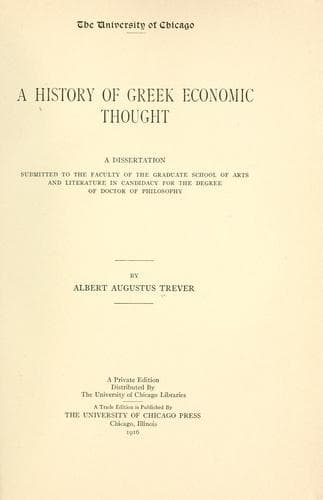
A History of Greek Economic ThoughtTrever, Albert Augustus
History
A History of Greek Economic Thought
Trever, Albert Augustus
Economics -- Greece -- History; Thesis (Ph. D.)
_Laws_ 742E, especially πλουσίους δ᾽ αὒ σφόδρα καὶ ἀγαθοὺς ἀδύνατον.
For the modern application of this doctrine, cf. _infra_; cf. also
743A, C; _Rep._ 550E, 551A.
Footnote 96:
_Rep._ 422; cf. 372E ff. on the φλεγμαίνουσα state.
Footnote 97:
373E; _Phaedo_ 66C. Compare the modern doctrine that lasting peace is
impossible under the present economic system.
Footnote 98:
_Laws_ 744D: διάστασις; also a basal idea of the _Republic_.
Footnote 99:
This is the spirit of the _Republic_ throughout, but cf. especially
369C-374D, and p. 25, n. 7.
Footnote 100:
_Laws_ 736E: καὶ πενίαν ἡγουμένους εἶναι μὴ τὸ τὴν οὐσίαν ἐλάττω
ποιεῖν, ἀλλὸ τὸ τὴν ἀπληστίαν πλείω. Cf. _infra_ on Xenophon for
similar ideas. Carlyle, _Sartor Resartus_, chapter on “Everlasting
Yea”: “The fraction of life can be increased in value not so much by
increasing your numerator as by lessening your denominator.” Ruskin,
_Time and Tide_, II, 5 ff. (Vol. XVII, 319 ff.); cf. 320, n. 1, for
other references. Thoreau: “A man is wealthy in proportion to the
number of things he can let alone”—an overemphasized truth.
Footnote 101:
So Socrates (_Apol._ 41E, 29D-E) and Jesus (Matt. 6:33).
Footnote 102:
_Laws_ 634A.
Footnote 103:
_Rep._ 329E-330A, 330D-331B; cf. also the prayer of _Phaedrus_ 279C:
τὸ δὲ χρυσοῦ πλῆθος εἴη μοι ὅσον μήτε ἅγειν δύναιτ᾽ ἄλλος ἢ ὁ σώφρων;
_Laws_ 679B; _Gorg._ 477E: τίς οὖν τέχνη πενίας ἀππαλλάττει; οὐ
χρηματιστική; cf. also 452C.
Footnote 104:
Cf. preceding notes; also _Rep._ 421D-E; _Laws_ 744D.
Footnote 105:
Bonar (_Philosophy and Political Economy_, pp. 13 f.) criticizes
_Rep._ 400-402 for not seeing that unlimited wealth is necessary for
the realization of the highest art and beauty.
Footnote 106:
Plato also emphasizes this, _Laws_ 743E, 870B: οὐ χρὴ πλουτεῖν ζητεῖν
τὸν εὐδαίμονα ἐσόμενον, ἀλλὰ δικαίως πλουτεῖν καὶ σωφρόνως; 660E;
though he implies that unlimited wealth is necessarily evil.
Footnote 107:
_Rep._ 552B-D; cf. Robin, _op. cit._, p. 243, n. 1, on κηφήν.
Footnote 108:
In _Mun. Pul._, III, 91 (Vol. XVII, 213), he makes Circe’s swine a
type of false consumption; cf. _Fors Clav._, Letter 38 (Vol. XXVIII,
30 ff.); _Mun. Pul._, Pref., 16 (Vol. XVII, 139 f.); _Queen of the
Air_, III, 124 ff. (Vol. XIX, 404 ff.); _Pol. Econ. of Art_, I, 48 ff.
(Vol. XVI, 47 ff.); _Unto This Last_, IV, 76 (Vol. XVII, 102); Mill
also attacked this idea.
Footnote 109:
_Unto This Last_, II, 40 (Vol. XVII, 56); cf. also _Mun. Pul._, II, 54
(Vol. XVII, 178 f.).
Footnote 110:
Discussed above.
Footnote 111:
Cf. _Pol._ 281D-283A, for an excellent description of the weaving
industry; also _Crat._ 388C ff.; _Phileb._ 56B, on carpentry.
Footnote 112:
_Pol._ 287D-289B; cf. Espinas, _op. cit._, pp. 35 f.; “L’Art économie
dans Platon,” _Revue des Etudes Grecques_, XXVII (1914), 106 ff.
Footnote 113:
Public-domain text, read in full here on John Shaqi.
Reviews
Reviews
No reviews yet
Be the first to share your thoughts on this work.
Elsewhere in the archive
Join the Discussion
Join the discussion
Sign in to leave a comment or review.
Sign InorCreate an account