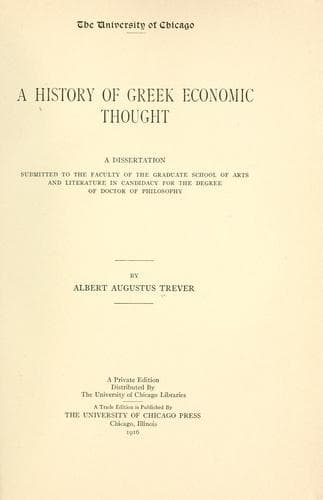
A History of Greek Economic ThoughtTrever, Albert Augustus
History
A History of Greek Economic Thought
Trever, Albert Augustus
Economics -- Greece -- History; Thesis (Ph. D.)
In his treatise on the _Revenues of Athens_, Xenophon shows some
appreciation of the theory of money. He appears to take for granted that
money must have intrinsic value. At least, he understands that silver is
a commodity whose value is affected by its use as such, as well as by
its employment for currency.[448] He also apprehends the value of a
silver currency for international commerce.[449] His naïvely
enthusiastic argument for the indefinite increase of the stock of
silver, however, is suggestive of the mercantile fallacy, which
identified money with wealth.[450] But perhaps he is merely using for
practical purposes of argument the fact that the Athenians were
accustomed to look upon silver as the metal for fixed and constant
value.[451] In any event, he sees that the increase of silver must be
attended by a corresponding increase in business activity, if its value
is not to depreciate,[452] and he cannot be accused of the error of the
mercantilists, that a country is impoverished by the export of
money.[453] He must also have understood clearly the importance of
stability of value in a currency, since he deems it necessary to show
that the increased output of silver will not decrease its value, and
that silver is the least changeable of the monetary metals.[454] Despite
his enthusiasm for his thesis, which causes him to exaggerate the
stability of silver, he does not fail to grasp the direct effect of
supply and demand upon it,[455] just as upon gold[456] and other
commodities.[457] He shows also some understanding of the quantitative
theory of the relation between gold and silver.[458] It need hardly be
added that, in strong contrast to Plato, his attitude toward the
precious metals, especially silver, is very favorable.[459]
EXCHANGE
Public-domain text, read in full here on John Shaqi.
Reviews
Reviews
No reviews yet
Be the first to share your thoughts on this work.
Elsewhere in the archive
Join the Discussion
Join the discussion
Sign in to leave a comment or review.
Sign InorCreate an account